
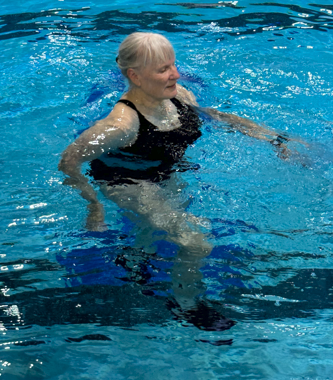
If you want a great workout in the pool, you can’t do better than deep water running. More research has been done on deep water running than on any other form of water exercise. Improvements in cardiorespiratory endurance and high calorie expenditure are well documented benefits. Deep water running can be practiced by everyone from elite athletes to water fitness class participants. Like every type of exercise, it should be performed with good form. That means that the spine is in neutral alignment, you are using a knee up/foot down motion, your shoulders are flexing and extending, your elbows stay bent and you are pulling them back so that your hand reaches your hips, your chest is erect, your shoulders are relaxed, your chin is level, and you are looking forward. In this position you are able to fully expand the lungs allowing your working muscles to get the oxygen they need. Click on Correct Form to see a video demonstration.
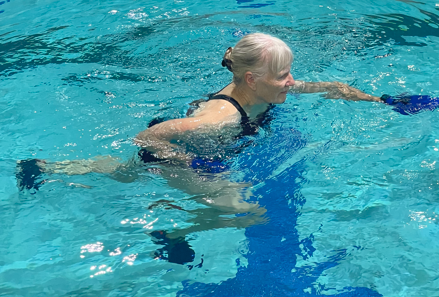
There are however some common mistakes in deep water running. The mistake I see most often is leaning forward, as in the photo on the right. In this position the water hits the chest first and slides down the torso, removing most of the resistance, and therefore most of the intensity. In addition, the position causes spinal compression, which means that the front edges of the vertebrae are touching. This can cause microfractures in someone with osteoporosis. There are also some common mistakes with the arm movement. These mistakes include swinging the arms across the chest, flexing and extending at the elbows, and not bringing the elbows back far enough. The shoulders should remain stationary, and not rock forward and back. The head should also remain level, and not rock from side to side. Click on Common Mistakes to see a video demonstration.
You can combine deep water running with assisting and resisting arm patterns to add muscular endurance training for the upper body. Some examples are (1) Crawl stroke, an alternating reach and pull motion; keep the arms under water where the resistance is. (2) Row, which is reaching and pulling with both arms together. (3) Double-arm press-down, which means stretching both arms out in front and pressing them down. (4) Breaststroke, which should be performed with the thumbs up to avoid combining internal rotation and horizontal abduction, a movement that is hard on the rotator cuff. (5) Rotator cuff sweep, which means keeping the elbows down near the waist and sweeping the hands out with the thumbs up. For more information on upper body exercises with deep water running, see Craig Stuart’s article “Wave Run” in the January-February-March 2026 issue of Akwa Magazine. Click on Upper Body Exercises with Deep Water Running for a video demonstration.
Deep water running can be performed at several intensity levels, depending on your goals. The basic deep water run is perfect for a water fitness class. Take it to a sprint if you wish to work harder or you are training for a 5k run. A power run is more intense, and can be used for intervals. Click on Increase Intensity for a video demonstration.
Although you do not run backward in daily life, traveling backward in the water is a good way to strengthen the back. For that reason I like to include some backward travel when I am doing a deep water running class. Again, good form is important. Participants frequently let their legs float up so that they are in a seated or semi-reclining position. This takes a lot of resistance out of the exercise, and the spine out of alignment, causing the spinal compression we wish to avoid. With the feet under the body, use a scull, a push forward or a reverse breaststroke to travel backward. Click on Travel Backward for a video demonstration.
I love deep water running. Try it out and you may love it too. See you in the pool!

Chris Alexander
Leave a Reply to Christine Alexander Cancel reply