
Improve Your Reaction Time

If you start to fall, you have only milliseconds to react. Will your ankle muscles contract to correct your balance? Will your hip muscles contract to shift your center of gravity to neutral? Will you take rapid steps in the direction of the fall? As you get older, you may notice that you are a little slower to react than you once were. Slower reaction time increases your risk of falling. The good news is that it’s never too late to improve your reaction time. Two things you can do are: train for power, and practice reacting to an unpredictable command.

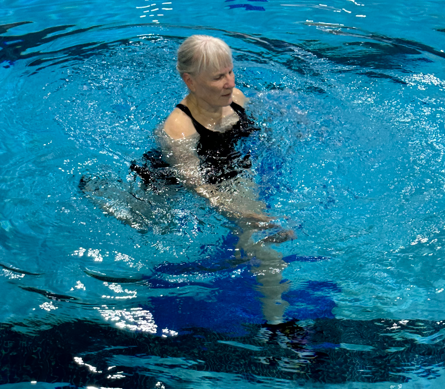
Train for Power. As we get older we lose power faster than we lose strength. Strength and power are not the same thing. Strength is how much force your muscles can produce; strength is lifting a heavy bag of groceries out of the trunk. Power is how quickly you can produce force; power is catching yourself when you trip, or stepping off a curb in time. Fast twitch muscle fibers are responsible for quick, powerful movement. With age, these are the first to be lost unless we give the body a reason to hold on to them. When you move with real effort or with speed in your water fitness class, you are calling on those fast, powerful muscle fibers. It may be tempting to take it easy in class, going through the motions while chatting with your neighbor. But if you want to strengthen those fast twitch muscles so that you can react to a potential fall situation, you need to push yourself. If you only cruise along comfortably, those powerful fibers are never called into action, and you slowly lose them. The beauty of water is that the faster you push against it, the more it pushes back, so it challenges you exactly as hard as you choose to work, and never any harder. Ease off and the resistance melts away instantly. Because the water supports your body, you can put real effort into your movement without jarring your joints. You can train for power with confidence. Pushing yourself means you are working, breathing a little harder, muscles engaged. Think short bursts of effort, then ease off and recover (intervals). You are moving with purpose and a little speed, not comfortably cruising or just going through the motions. Click on Cross-Country Ski for a short video that demonstrates pushing against the water by increasing range of motion, increasing speed, adding elevation, adding power, or adding rotation. Each variable is performed in deep water for 4 counts.

Practice Reacting to an Unpredictable Command. You need your instructor to help with this one. Events that lead to a fall are not predictable. In your water fitness class your instructor normally lets you know what is coming and gives you time to switch to the next exercise. Usually you perform that exercise for a sufficient amount of time so that you feel comfortable with it. When your instructor uses the Unpredictable Command technique, the movements are atypical and the change to the next move is rapid fire. When I use the technique, I do not have a specific script, but instead I make it up on the spot, so that it is always unpredictable. A sequence might look something like this: knee lift with the right leg, push the left hand forward, put the right hand on your hip, push the left hand forward and side, look over your right shoulder, press your palms together and look forward, jog with both feet, turn to your left, take 3 steps left and one step right, swing the left leg forward and back while making fists and stretching the fingers, make a fist with one hand and stretch the fingers with the opposite hand, go into a cross-country ski and clap one hand at a time, turn to your right and travel backward. You get the idea. Physical activity that combines movement with decision-making and coordination, requires balance, timing, and problem-solving. It challenges both the body and the brain simultaneously. So the next time you are in a crowd and someone steps in front of you unexpectedly, or you are walking the dog and he decides to chase after that squirrel, or you stub your toe on a change in elevation in the sidewalk, your reaction time may be just a little quicker.

See you in the pool!

Author/Instructor Photo

Chris Alexander

Resources: Marietta Mehanni, “Why It Pays to Push Yourself,” 2026. David Ogden, The Unpredictable Command Technique, 2001. Ruth Sova, “Never Too Old to Train the Brain,” 2026, Ruth Sova, Balance and Fall Prevention, 2026.
Leave a Reply

Your email address will not be published. Required fields are marked *

Improve Reaction Time

According to the Centers for Disease Control, one in four older adults reported falling in 2018. This equals about 30 million falls. Of that number, 8 million falls required medical attention or limited activity for at least a day. By 2030 there will be 72 million older adults and 52 million falls. Obviously one of the reasons for falling is a balance issue. But another contributing factor is decreased reaction time.

Robert H Schmerling, M.D., the Senior Faculty Editor for Harvard Health Publishing wrote an article in the Harvard Health blog entitled “My Last Fall: Reaction Time and Getting Older.” After he fell and suffered an injury while running, he got to wondering why falls tend to cause more serious injuries as we age. He points out that children are able to catch themselves by stretching out a hand or by making a quick turn of the body or by grabbing a railing before they land too hard. But reaction times tend to slow as we age. This is because of slowed signals from the brain to the nerves and muscles, reduced flexibility of joints and tendons, and weaker muscles. Older adults also tend to have less accurate awareness of their extremities’ position in space.

Lois A. Bowers posted an article on the McKnights Senior Living website on research published in the American Journal of Physical Medicine & Rehabilitation that confirms the importance of reaction time. The research was conducted by James Richardson, M.D at the University of Michigan Comprehensive Musculoskeletal Center. He found that senior adults who had good reaction times were able to balance on one leg for a longer period of time than those whose brains worked more slowly.

Fortunately, exercise can help improve reaction time. The Exercise and Sports Science Australia published a Position Statement on Exercise and Falls Prevention in Older People in 2011. They recommend exercises that progressively challenge the base of support, such as going from a two-legged stand, to a tandem stand, to a one-legged stand. From there move to exercises that use dynamic movements to challenge the center of gravity, such as tandem walk, circle turns, leaning and reaching activities, and stepping over obstacles. You can reduce sensory input by standing with eyes closed or standing/walking on unstable surfaces such as foam mats. Further challenges can be provided by the use of dual tasks, such as combining a memory task with a gait training exercise or a hand-eye coordination activity with a balance task. Many of these exercises can be performed in a water fitness class as well as on land (except for walking on foam mats). Participants often feel more comfortable doing the exercises in the pool because the hydrostatic pressure of the water reduces the risk of falling.

Another technique for improving reaction time is the Unpredictable Command. Ruth Sova, MS, the president of the Aquatic Therapy and Rehab Institute, wrote an article entitled “Seated and Standing, Static and Dynamic Balance” in the October/November 2019 issue of Akwa magazine. A membership in the Aquatic Exercise Association/Aquatic Therapy and Rehab Institute includes a subscription to Akwa magazine. Members can access previous issues of Akwa in the members only section of the website. Ruth Sova’s sample lesson plan in her article gives an idea of what an unpredictable command routine is like. The lesson plan is reprinted here with permission.

  • March in place.
  • Turn your head to the right.
  • March left.
  • Walk on tiptoes backwards still looking right.
  • March in place on tiptoes. Circle your right arm.
  • Walk forward normal stride while looking forward with eyes up. Reverse the circle on your right arm.
  • Center your eyes and walk on the outsides of your feet back to the right diagonal. Stop circling your arm. March in place. Look at your left hip.
  • Turn 90 degrees to the right and walk backwards. Side step to the right 4 steps. Press your hands up and down. Look forward.
  • Sidestep left, turn your palms up and continue pressing up and down. Look at your right elbow.
  • Turn 90 degrees to the right and march in place with your toes pointed in. Walk forward with your toes pointed out. Look forward.
  • Walk backwards with your right foot pointed out and your left foot pointed in.
  • Stop moving. Circle your left arm and swing your right arm forward and back. Walk forward.
  • With your arms still moving, turn 90 degrees to the right and side step right on the insides of your feet (toes pointed forward). Look up to the left.. Reverse your circling arm.
  • Do alternating knee lifts in place. Turn your right knee out. Look forward. Stop arm movement. Turn your left knee out and turn 90 degrees to the right.

By the age of 30-40 we all have postural issues and muscle imbalance that can lead to balance concerns. Adding in a section of unpredictable commands to your water fitness class will be beneficial for everyone. You can choose a section from Ms. Sova’s sample lesson plan, or make up your own. My book Water Fitness Progressions has a lesson plan on Balance that includes some unpredictable commands. Improving reaction time may prevent your participants from becoming a fall statistic in the future.

See you in the pool!

Author/Instructor Photo
Chris Alexander