Now What?

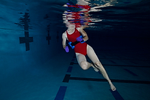
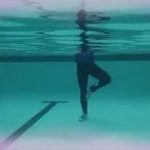
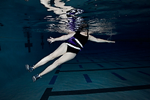
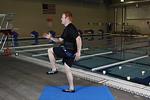
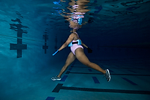
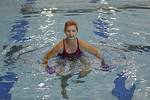
My last 4 blog postings have been about building your exercise library. And if you are exercising in the pool on your own or teaching a water fitness class, it is important to build your exercise library. But how do you put it all together into a workout? You could just get in the pool and start doing whatever exercise comes to mind. Would there be a problem with doing the deep water exercises in the order of the pictures below?

The exercises are jumping jacks, jog with a diagonal lean, side to side extension, knee high jog, lateral flexion, power run, cross-country ski, and jog with elevation. All of these are good exercises, but would you want to do them in this order? Of course not! But why not? You would be asking your body to jump right into cardio, drop down into core work, go back into cardio, stretch, go into high intensity cardio, and then you’re done.

It would be much better for your body to give it time to work up to higher intensities and then let it come down gradually. That’s why a good workout has 4 distinctive parts:

  1. The warm up. When you first get into the pool, the water feels cold. That’s because the pool temperature is perhaps 15 degrees cooler than body temperature. You need to acclimate to the environment of the water, warm up the muscles, and increase the metabolic rate in order to be ready for your workout. Start with a vigorous short-lever exercise, such as a knee-high jog. Then add long lever exercises, such as a jumping jack. The warm-up should last from 5-10 minutes.
  2. The conditioning phase. This is the main part of your workout. If your goal is cardiorespiratory endurance, then you want to do exercises that get your heart rate up. Cross-country ski is the perfect exercise for this! You can also increase intensity by adding acceleration, (as in the power run) or elevation. Your conditioning phase lasts 20-50 minutes, depending on how long your want your workout to be or how long your class is.
  3. The cool down.  You need your heart rate to return to its resting state. So you will start to slow down by using lower intensity exercises. The jog with a diagonal lean is a good transitional exercise. It is less vigorous than a power run and it adds in a core challenge to maintain alignment. When the heart rate has come down, you can do toning exercises or core exercises, such as the side to side extension. The cool down lasts 5-15 minutes.
  4. The post stretch. The best time to work on flexibility is now, when the muscles are still warm. Lengthen a muscle and then hold it in a static stretch. Or move the joints through their full range of motion in a dynamic stretch. Aim to stretch for at least 5 minutes.

It may take some planning to put together a workout that is not just a random set of exercises, but your body will thank you.  I’ll bet you can rearrange those pictures above into a better order now.

IMG_4509

See you in the pool!

Chris Alexander

For more information about organizing workouts, see my book, Water Fitness Lesson Plans and Choreography. You can find out how to order it on my website at www.waterfitnesslessons.com

The Perfect Water Fitness Exercise

Johnnene CC Ski

If I had to pick a favorite exercise, hands down it would be cross-country ski. It’s the perfect exercise! The basic ski is a long lever exercise, so it can be used for both high intensity and improved range of motion. And there are multiple variations. Cross-country ski can be used in both shallow water and deep water. Let’s look at some of the possible variations of the deep water ski.

But first, check to make sure you are performing the ski correctly. You want full hip flexion and hyperextension, as much as your body will permit comfortably, so be sure not to limit the range of motion to forward flexion, or your ski becomes a kick forward. You can check to see how much hyperextension you are getting by doing your cross-country ski with your back to the pool wall. How close do you have to get to the wall before your back heel taps the wall?

Cross-country ski can be changed to a short lever move by keeping the knees bent at 90 degrees when decreased intensity is desired. Tuck ski is another less intense variation. In tuck ski together, you tuck your feet under your body, go into your ski position with one hip flexed and the other hyperextended, then pull both straight legs to center. A mini ski is smaller than a cross-country ski but bigger than a flutter kick.

The basic arm movement is shoulder flexion and hyperextension. Aim for full range of motion. The hands can slice through the water, or you can increase intensity by making the palms face the direction of motion. Try other arm movements, such as lat pull-down (shoulder adduction and abduction), shoulder sweep (horizontal adduction and abduction), arm curls (elbow flexion and extension), or rotator cuff sweep (shoulder external and internal rotation). Use alternating arms or arms in unison, or use just one arm and put the other hand on your hip or behind your back. One-arm moves challenge the core muscles.

The working positions for cross-country ski are upright, diagonal and side-lying. Tuck ski together can also be performed side-lying.

There are many ways to increase intensity with cross-country ski. Increasing the speed of a long lever move like cross-country ski without decreasing the range of motion is a challenge. It is easier to increase speed with a mini ski. Increase the range of motion and the intensity by making your ski bigger in what is sometimes called an over stride. Skiing with rotation, in which the arms reach across the midline of the body, also increases the range of motion. Tuck ski can be performed with rotation too. Try the helicopter ski, in which the arms and legs sweep around the body in semicircles instead of the usual flexion and hyperextension. Another way to increase intensity is to add acceleration, or power. Accelerate through the entire move or accelerate toward the center, lifting your shoulders out of the water in what is sometimes called a power pop. Accelerate toward center with your tuck ski together too. Half turns increase intensity and are fun to perform. Ski 3 counts or 7 counts, then make your half turn.

Yet another way to increase intensity is to travel. Travel forward is not difficult to learn. Travel backward requires some upper body strength. You have to scoop the water forcefully with your hands cupped during the flexion phase of your arm swing. You can also sweep alternating arms to center or use a reverse breaststroke. Sweep both arms to one side to travel sideways, or travel sideways in the diagonal working position.

Cross-country ski can be combined with other exercises to make new moves. In a ski-jacks pyramid you perform 8 skis and 8 jacks, then 4 skis and 4 jacks, then 2 skis and 2 jacks, and finally one of each. Cue: ski, ski, jack, together. Alternate a tuck ski together with a frog kick, power popping with both moves. In a ski pendulum you move from upright to diagonal to side-lying and back. Ski side-lying 4X, then tuck, pike, tuck and ski side-lying on the other side 4X. Cross-country ski and hold the position; travel forward with a breaststroke or backward with a reverse breaststroke. As you can see, there are lots of things you can do with cross-country ski!

All of the basic water fitness exercises have variations. My last Blog post described variations for jogging in shallow water. For variations of other exercises, see my book Water Fitness: Lesson Plans and Choreography. Check out my website at www.waterfitnesslessons.com for information on how to purchase the book.

See you in the pool!

IMG_4509


New Exercises for a New Year

Adam deep water jog   Adam straddle jog   Amos heel jog

Can you believe that 2016 is here already? Perhaps your class took a break for the holidays, but now it is time to get back into your routine. Freshen up that routine with some new variations on one of the basic exercises for shallow water.

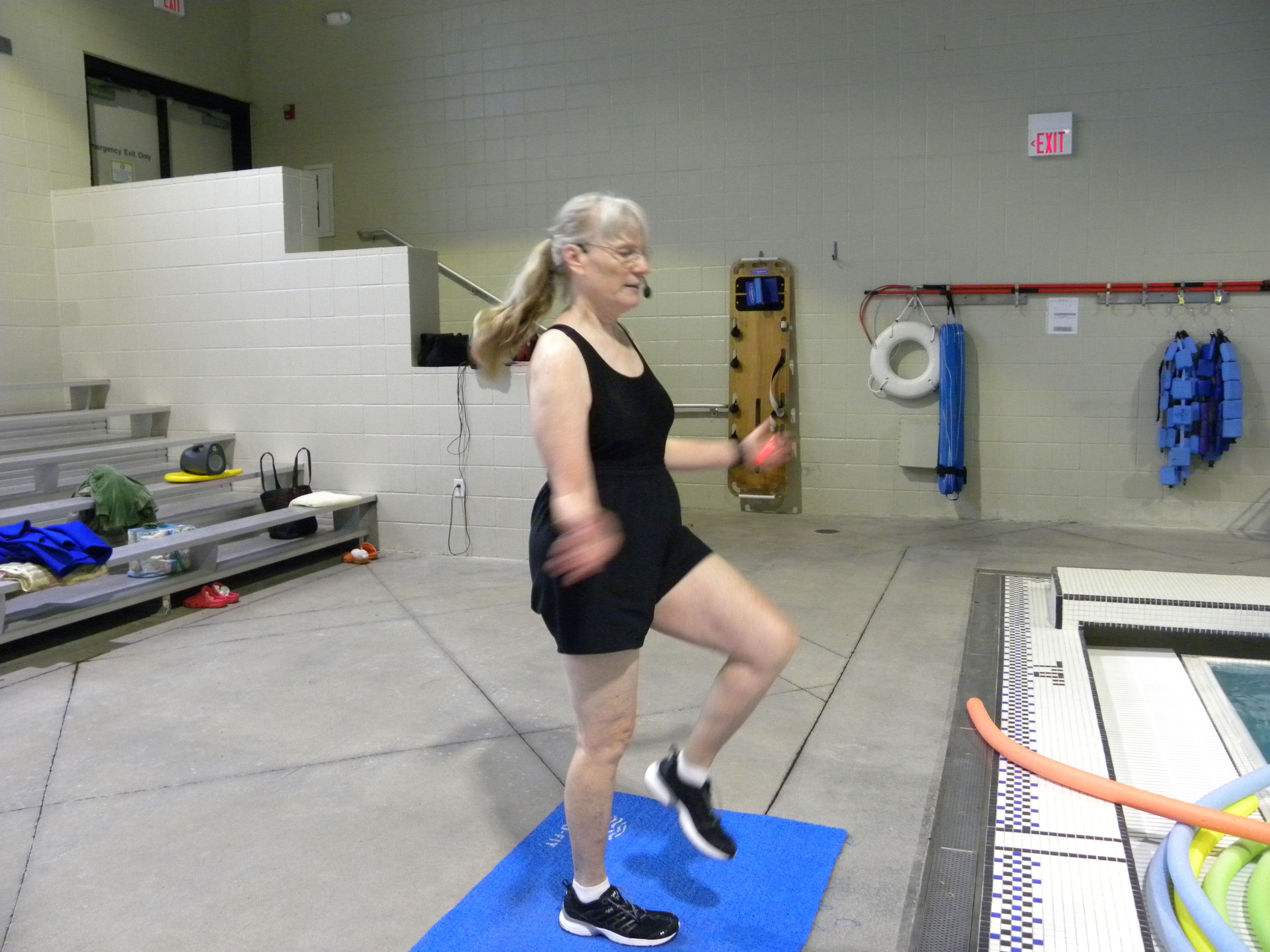
Variations were described in my last Blog post. This time I’d like to apply those variations to a specific exercise: the knee high jog. Before adding any variations though, make sure that you are jogging with good form. The spine is in neutral, the core is braced so that the shoulders are stationary and the head is not rocking from side to side, and the thighs are coming up no higher than parallel to the floor.

If you open up the hips, the knee high jog becomes a straddle jog. If you lift your heels instead of your knees, it becomes a heel jog.

Now change the arm moves. Try an arm swing, a lat pull-down, a shoulder sweep, a shoulder blade squeeze, a row, an arm curl, a triceps extension, or a rotator cuff sweep. The arm swing can be done with unison arms, the lat pull-down with alternating arms and the shoulder sweep can become a breaststroke or reverse breaststroke. Slice the hands or make the palms face the direction of motion. Put one hand on the hip and perform the arm move with a single arm. Add pulses. Combine moves, for example a lat pull-down and a shoulder sweep. Or jog with hands on hips, arms floating near the surface of the water, or sculling.

Vary the tempo. Water tempo jogging can easily be sped up to land tempo without losing range of motion. With a half water tempo you will bounce on both feet, lift one knee (or heel), bounce on both feet and lift the other knee (or heel). Pauses can be added to challenge balance. For example, “single, single, hold” means lifting the R knee, L knee, R knee and hold for 2 counts. With doubles you lift each knee 2 times. “Single, single, double” means R knee, L knee, R knee, R knee. Syncopate is 2 counts at water tempo and 3 counts at land tempo, sometimes described as slow, slow, quick quick quick.

Knee high jog, straddle jog and heel jog can all be done with rebounding. Perform the knee high jog in the neutral position by flexing the knees and hips to submerge the body to shoulder depth. A straddle jog in neutral becomes a frog jump. A heel jog becomes a seated hamstring curl. A suspended jog is a seated leg press with hands sculling or you can do a suspended bicycle instead. Frog jumps become suspended frogs. Seated hamstring curls can be done without touching the floor. All 3 types of jogs can be done grounded. One foot stays on the floor and the other knee is lifted in front or to the side or the heel is lifted in back. Try doing 1-4 R knee lifts, R side lifts, R heel lifts, then switch to the L leg.

Increase the range of motion by taking the feet wider apart. Knee high jog and straddle jog become run tires (like running through tires in football practice) or you can leap forward or sideways. Heel jog can be done with the feet apart or turn the short lever into a long lever and do a skate kick. Cross the mid-line of the body with crossover knees or an inner thigh lift or a hopscotch.

Power can be added to any of these moves. So can turns and traveling in multiple directions.

Some of the most interesting variations are created by combining 2 or more moves. In, in, out, out is a combination of knee high jog and run tires. Combine in, in, out, out with 2 jacks or with one inner thigh lift or with one hopscotch. Chorus line kick is one knee lift and one kick. Do 3 straddle jogs and one side quad kick. Or 3 heel jogs and one kick to the corner. Try more complex combinations such as R knee lift, L knee lift, L quad kick, L lunge. The lunge goes into a L knee lift and the sequence repeats. Use your creativity and you will be able come up with your own new combinations.

What Exercises Can You Do in Deep Water?

Can you do the same exercises in deep water that you can do in shallow water? You can do some of them, but not all, and there are some exercises that you can do in deep water that you can’t do in shallow. When you are building your exercise library for deep water, remember that there are only a few basic exercises and all other exercises are variations of these.

The basic exercises in deep water are jog, bicycle, kick, cross-country ski and jumping jacks. If you do the jumping jacks with the arms and legs opposite, as shown in the start and finish photos, then you will not bob up and down.

Just as in shallow water, there are many ways to vary these 5 exercises.

  1. Use different arm movements.  Try arm swing (shoulder flexion and extension), lat pull-down (shoulder abduction and adduction), shoulder sweep (horizontal shoulder abduction and adduction), arm curls (elbow flexion and extension), or rotator cuff sweep (shoulder external and internal rotation).  Use alternating arms or both arms in unison. If you use one arm, or no arms, you will challenge your core muscles, because it will be harder to maintain neutral posture.
  2. Vary the tempo. The speed at which exercises are performed in deep water is slower than in shallow water because the range of motion is greater. But you can still vary the tempo with pauses (single, single, hold) or syncopate (slow, slow, quick, quick, quick). You can also increase the speed, especially with smaller moves such as flutter kick, mini ski and mini jacks.
  3. Change the working position. Exercises can be performed upright, at a diagonal angle, side-lying, or seated. Use a scull to lift the shoulders out of the water.
  4. Increase the range of motion. Exercises can be performed with larger arm or leg movements, or the feet farther apart, or you can cross the midline of the body.
  5. Add acceleration or power, by pushing harder against the resistance of the water. If you accelerate toward center in what is sometimes called a power pop, you can lift and lower the shoulders in and out of the water in a very high intensity move.
  6. Add turns. You can do quarter turns, half turns, or full turns. Diagonal turns are quarter turns toward the right corner, then toward the left corner.
  7. Travel. You can travel forward, backward, and sideways. Although you can travel using leg motions only, most travel in deep water depends on arm movements. If you lean diagonally toward the side, you will travel sideways. If you are in a side-lying position, it will be the leg movements that propel you sideways. You can travel in patterns, such as a diagonal line, circle, square, bow-tie pattern, zig-zag, or scatter pattern.
  8. Combine exercises. Putting two or more exercises together creates a new exercise. Examples include log jump right, jacks tuck, log jump left; quad kick front and side; tuck ski and jacks tuck alternate; and cross-country ski side-lying right, tuck, pike, tuck, cross-country ski side-lying left.

Not every variation will work with every exercise. But using even a few variations will increase your exercise library tremendously.

Note: the photos are from my book, Water Fitness lesson Plans and Choreography. For more information on the book, check out my website at www.waterfitnesslessons.com

What Exercises Can You Do in the Pool?

Whether you are exercising on your own in the pool, or you are a water fitness instructor getting ready to teach a class, you need to have a collection of exercises you can use. You want exercises that are fun, and you probably want some of them to raise your heart rate into your target zone.  Building an exercise library can seem like a daunting task.

It helps to remember that there are only a few basic exercises and all other exercises are variations of these.  The basic exercises in shallow water are walk, jog, kick, rocking horse (shown as starting position and finish), cross-country ski, jumping jacks and jump.

Now how do you create variations of these exercises?

  1.  Use different arm movements. Try arm swing (should flexion and extension), lat pull-down (shoulder abduction and adduction), shoulder sweep (horizontal shoulder abduction and adduction), arm curls (elbow flexion and extension), or rotator cuff sweep (shoulder external and internal rotation). Use only one arm, use both arms in unison, use alternating arms, or no arms.
  2. Vary the tempo.  Water tempo is the normal speed used in water. Land tempo is faster, but you want to be sure not to lose your range of motion. Half water tempo adds a bounce on every other beat. You can also add variations in tempo such as pauses, doubles, and syncopate. An example of a pause is single, single, hold. Single, single, double means one right, one left, two right, and so on. Syncopate means slow, slow, quick quick, quick.
  3. Change the working position, also called the impact option.  Exercises can be performed upright with some rebounding, in the neutral position with the hips and knees flexed to submerge the body to shoulder depth, suspended with the feet not touching the floor, and grounded or keeping one foot on the floor at all times.
  4. Increase the range of motion. Exercises can be performed with larger arm or leg movements, or the feet farther apart, or you can cross the mid-line of the body.
  5. Add acceleration or power, by pushing harder against the resistance of the water.
  6. Add turns. You can do quarter turns, half turns, or full turns. Diagonal turns are quarter turns toward the right corner, then toward the left corner.
  7. Travel. You can travel forward, backward, sideways, or on a diagonal. If you are traveling on a diagonal you do not face the direction of travel, which would be the same thing as traveling forward, but rather you continue to face forward while traveling toward a corner. You can travel in patterns, such as in a circle, square, bow-tie pattern, zig-zag, or scatter pattern.
  8. Combine exercises. Putting two or more exercises together creates a new exercise. Examples include the chorus line kick (which is one knee lift and one kick), quad kick front and side, jumping jacks squat, and ski-ski-kick-and-lunge.

Not every variation will work with every exercise. But using even a few variations will increase your exercise library tremendously.

Note: the photos are from my book, Water Fitness Lesson Plans and Choreography. For more information on the book, check out my website at www.waterfitnesslessons.com