Buoyant Equipment: Dumbbells

markgrevelding_mug   Foam dumbbells

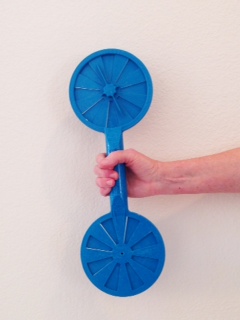
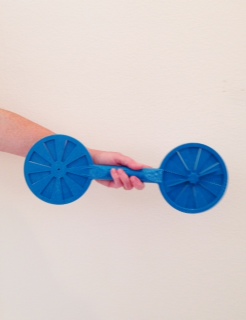
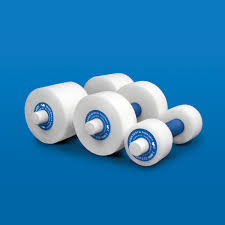
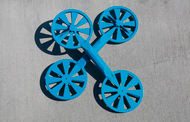
Nearly every pool has foam dumbbells and participants love to use them! In some places they use dumbbells for every class. Often they grab the largest dumbbells available. Is this a good thing?

The Metroplex Association of Aquatic Professionals hosted Mark Grevelding at a Continuing Education Training on April 21. One of his workshops was a Noodle & Buoy Circuit.  Mark discussed exercise safety with dumbbells. He says that the main thing people do with dumbbells is push them forward and plunge them down.

Every time you submerge foam dumbbells under water, your shoulder stabilizers contract. When you push dumbbells forward you are using them like drag equipment. Your latissimus dorsi and lower trapezius contract isometrically to hold the dumbbells under the water. You get some work for the targeted muscle groups (chest and triceps), but these are not the muscle groups that get most of the work. Plunging the dumbbells down uses the shoulder stabilizers and works the triceps. It is easy to see that too much of this will put undue stress on the shoulders, which can lead to a shoulder injury.

Not only do some people use the dumbbells for every workout, but they also select the largest dumbbells available. They may not be able to keep the shoulders neutral with equipment this buoyant, so the shoulders are elevated. They may not be able to control the dumbbells without throwing their body weight into the exercise. They may have to reduce the range of motion as a result of this loss of control. It is easy to see that too much of this will put undue stress on the shoulders, which can lead to a shoulder injury.

So what are foam dumbbells good for? Well, I’d love to show you some pictures of exercises with the dumbbells, but when I Googled pictures of water exercises with foam dumbbells, all they had were pictures of pushing them forward and plunging them down! So you’ll have to use your imagination. Choose a size that you can manipulate while keeping the shoulders relaxed and the spine in neutral alignment. Relax your shoulders and fingers between each set. Use the dumbbells for only part of a class.

  1. Chest. In a lunge position, lean forward 45 degrees and perform a chest fly, like clapping your hands, or a chest press, pushing at an angle toward the floor.
  2. Lats. In an upright lunge position, perform a lat pull-down, like jumping jacks arms.
  3. Triceps. In a squat or lunge position, with elbows by the waist, perform a triceps extension. Or plunge the dumbbells down at the sides.
  4. Squats and lunges. Hold the dumbbells down at your sides while you perform these exercises to add resistance as you lower the body toward the floor.
  5. Calf raises. Hold the dumbbells down at your sides while you rise up on your toes to add resistance as you lower your heels back to the floor.
  6. Plank and side plank. Hold both dumbbells directly under the shoulders for the plank and one dumbbell directly under the shoulder for a side plank.

There are a lot of muscle groups missing from this list, like the upper back, shoulders and biceps. That’s because foam dumbbells only add resistance when you are pushing them toward the pool floor. The buoyant dumbbells want to float to the surface of the water, which means there is no resistance for any exercise that involves lifting them. Another thing missing from this list is using the buoyant dumbbells for support in a suspended position. When the body is suspended from dumbbells held in the hands or placed under the arms, the shoulders are unacceptably loaded, the tendons are pinched, and nerve damage may occur in the arm pits (Ivens and Holder, Do No Harm, 2011).

The bottom line is that foam dumbbells are a lot of fun and they offer some good resistance for a limited number of exercises. For more information on using dumbbells, including a chart showing which muscles are being trained with various exercises using buoyant equipment, see my new book Water Fitness Progressions. The book also contains lesson plans using dumbbells for both shallow water and deep water classes. The book can be ordered from Human Kinetics (the publisher) or from Amazon.com. Just click on whichever source you wish to order from and the link will take you there.
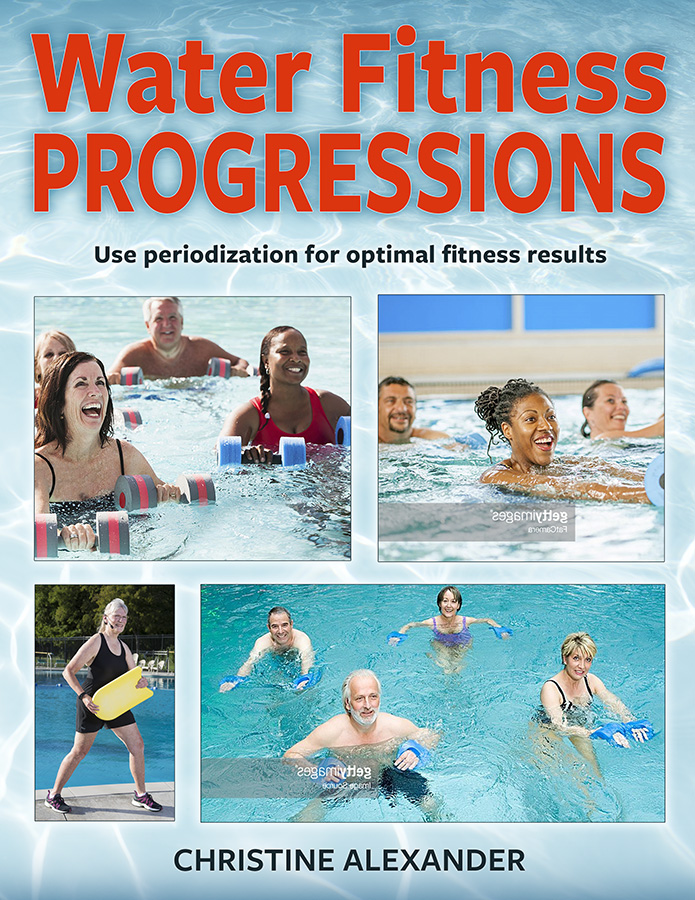
Mark Grevelding wrote about my book in his Blog. Check out his post at https://fitmotivation.com/blog

See you in the pool!

IMG_4509

Chris Alexander


More about Noodles

Noodles from Book   Noodle Hydrofit

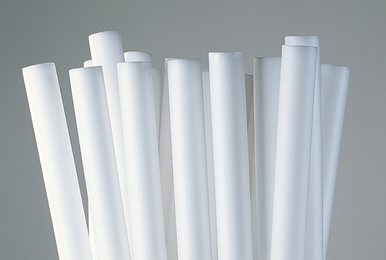
Noodles are popular in water fitness. Often we think of using noodles for support during suspended exercises in shallow water. Of course we can do those same exercises without a noodle in deep water because we are already supported by a deep water belt. In both shallow and deep water noodles can also be used as a piece of buoyant resistance equipment. Buoyant means that the equipment floats toward the water’s surface. Buoyant equipment is only offering resistance when you are plunging it toward the pool floor.

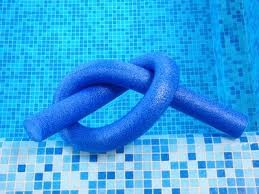
The colorful noodles available at most pools do not offer a great deal of resistance making them ideal for beginners and for whenever you plan to do many repetitions of an exercise.  When greater resistance is desired, some people tie the noodle in a knotNoodle Knot to increase its surface area. I am not a big fan of that because it makes the noodle curly and useless for any other purpose. A better option is to use the larger more dense foam noodles available from Hydro-Fit. You can also progress to using foam dumbbells instead of noodles.
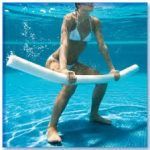
Since the resistance of a noodle occurs only when you are plunging it toward the pool floor, you need to be aware that you can only work one muscle of a muscle pair with this equipment. Hold the noodle in both hands with the palms facing up and perform an arm curl. You might think you are training the biceps, because that is what you would be training with weighted dumbbells in the gym. But the noodle wants to float to the surface anyway, so you are not using the biceps at all. Pull the noodle down toward the floor as if you are lowering weighted dumbbells and you are using the triceps, because the noodle is resisting that downward movement. Since the “arm curl” works the triceps, I prefer to turn the palms down (which puts less stress on the fingers), press the noodle toward the floor and call the exercise a “triceps extension.” The triceps contract concentrically in this exercise. If you slow down the noodle’s flotation toward the surface of the water, the triceps work eccentrically. If you wish to work the biceps, you may need to use a different kind of equipment.

Noodle resistance exercises can be performed with the noodle held in both hands (make sure the hands are shoulder distance apart), with the noodle held in one hand, and with the noodle under one foot. Some examples of strength training exercises you can do in shallow water with the noodles are:

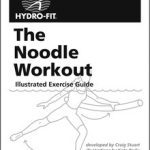
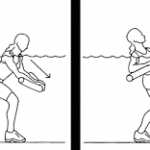
  1. The chest press is shown in the Hydro-Fit drawing above. The exerciser is performing a rocking horse along with the chest press.
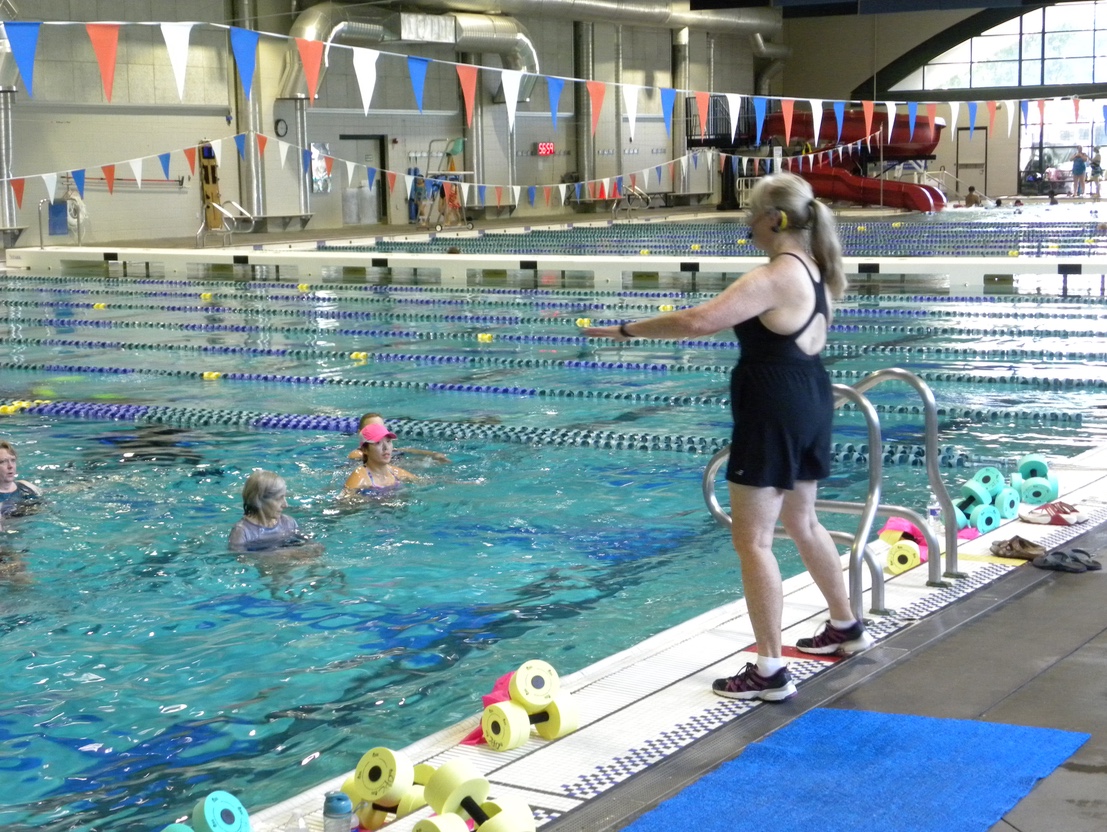
  2. The lat-pull down is being demonstrated by the instructor on the deck. The noodle is held in one hand extended to the side and is pressed down toward the floor.
  3. The squat is shown in the picture with a Hydro-Fit noodle. The noodle is being held down with the hands while the squat is performed, resisting the downward phase of the squat.

Shallow-water exercises with noodles need to be modified for deep water. For example, you cannot perform a rocking horse in deep water. However, you can do a chest press while leaning forward 45 degrees. A flutter kick in this position may help you stabilize while focusing on the pectoral muscles of the chest. Jog while performing the lat pull-down. The noodle will force you to travel sideways creating a challenge for the core muscles to maintain neutral posture while the lats are being trained. You cannot do squats in deep water, but you can place the noodle under one foot and perform a standing leg press.

For a chart showing which muscles are being trained with various exercises using buoyant equipment, see my new book Water Fitness Progressions. The book also contains lesson plans using noodles for both shallow water and deep water classes. The book can be ordered from Human Kinetics (the publisher) or from Amazon.com. Just click on whichever source you wish to order from and the link will take you there. Another resource for exercises with noodles is The Noodle Workout which is available from Hydro-Fit. Click on the Hydro-Fit link to order the booklet.

Have fun with your noodles! See you in the pool!

IMG_4509

Chris Alexander


Water Fitness Progressions

fullsizeoutput_1e57   I like my class participants. Over the years I’ve heard about their families, their pets, their challenges, and which of my playlists they like. They are more than just class participants, they are friends. I want them to get a good, safe, effective workout every time they come to my class. I don’t want to bore them with the same old routines. I want to challenge them to progress in their levels of fitness. I want to help them make their hearts stronger, to give them an opportunity to improve their muscular endurance, to challenge them mentally, and I want them to have fun doing it.

This means I have to keep learning. That’s why I attend conferences, workshops, and webinars and read water fitness books and articles. One of the things I’ve been looking for is a system for offering progressions. One system that I learned about is periodization. It’s a training tool used by athletes to help them be in the best possible shape during the most challenging season of their sport. Periodization divides the year into 4 seasons, Preseason, Transition Season, Peak Fitness Season and Active Recovery. Why not use this tool to train for the sport of daily living?

My experiments with periodization have become the basis for my new book, Water Fitness Progressions, which has just been published.

Chris Book Cover

Each season has its own focus. In the Preseason we focus on improving posture, performing the exercises with good form, increasing range of motion, doing low intensity intervals, and using the properties of water to create overload. In the Transition Season we improve the quality of our movement by paying attention to how the arms and legs move the water, increase interval training to moderate intensity, and add equipment to sessions of strength training. In Peak Fitness Season we focus on increasing power, performing high intensity interval training (HIIT) and using both concentric and eccentric muscle actions in our strength training with equipment. In Active Recovery we give our bodies a chance to repair any microtrauma that may have occurred during the previous months. We do light cardio-respiratory training, core strength training and have fun activities such as games or relay races to provide a mental break.

The book explains how to do all of this, complete with lesson plans. Each interval lesson plan has 3 versions, a low intensity version, a moderate intensity version and a high intensity (HIIT) version. There are strength training lesson plans using various properties of the water, using buoyant and drag equipment, and focusing on eccentric muscle actions. There is also a section of fun activities.

Thanks to the American College of Sports Medicine, the Aquatic Exercise Association, Pauline Ivens and Stephanie Thielen, who all provided some of the ideas used in this book. My special thanks goes to my water fitness classes, who are my inspiration. The book can be ordered from Human Kinetics (the publisher) or from Amazon.com. Just click on whichever source you wish to order from and the link will take you there.

See you in the pool!

IMG_4509

Chris Alexander

Pool Tools: Noodles

Noodles

Back when I started teaching water fitness in the early 1990’s, the only equipment we had was milk jugs, which we held under our arms for support during suspended exercises.

Milk jug  Milk jug  What was wrong with that? Plenty! When the body is suspended from milk jugs, the shoulders are unacceptably loaded, the tendons are pinched, and nerve damage may occur in the arm pits (Ivens and Holder, Do No Harm, 2011). Fortunately, today we have better equipment options.

One of the oldest and most popular options is the pool noodle. It is inexpensive (around $3 to $5 each) which means most facilities can afford them, and there are many ways to use them. One way is to use them under our arms for support during suspended exercises, just as we did with the jugs. But if we hang from noodles under our arm pits, we risk the same shoulder, tendon and nerve damage that occurred with the milk jugs. To avoid that risk, position the noodle below the shoulder blades with the arms resting on top of the noodle in a position called “posterior sling.”                                                                                                                                                                         Adam noodle kick

In this position, we can do kicks from the knees, flutter kicks, bicycle, leg press, seated jacks and ankle flexion. Alternate the legs or work only one leg. The kick from the knee, bicycle, leg press and ankle flexion can be performed with the legs in unison.  For the core muscles, you can do a seated waist twist, and recline backward for crunches.

Sit on the noodle like a swing to do most of those same exercises, and you have added a balance challenge because this position is less stable. You can not do crunches sitting on the noodle like a swing, but you can hike the hip side to side to work the obliques. Try holding on to the noodle with both hands, with just one hand or with arms extended to the sides. Place the arms inside the noodle or outside the noodle for arm movements. Sweep one arm either out or in to turn in a circle.

Kathy straddle noodle

When greater stability is desired, straddle the noodle as if riding a bicycle. All the leg movements you do with the noodle in a posterior sling can be done while straddling the noodle, including reclining for crunches. Squeeze the noodle between the knees to add resistance on the waist twist. Try crossing the ankles and using the arms only. Now you can row, do the breaststroke or reverse breaststroke, unison arm swing, clap hands, and rotator cuff sweep. Bicycle with both the arms and the legs. Bicycle races are a fun way to end a class.

More on noodles in my next post. See you in the pool!

IMG_4509

Chris Alexander


Holidays in the Pool

Santa

There is a lot to do during the holiday season: shopping, wrapping presents, decorating, baking, holiday parties and more. You know your water fitness class participants need to maintain their exercise routine to help them manage the holiday stress, but sometimes exercise moves near the bottom of their priority list. Try some of the following ideas to make your water fitness class more festive and encourage everyone to keep coming:

Holiday Music. Break out some holiday music to get everyone in a festive mood. All the fitness music companies have Christmas music playlists for sale. Check out:

(1) Super Happy Xmas Step (128-130 BPM) and Xmas Buzz (135 BPM) at Yes Fitness Music www.yesfitnessmusic.com.

(2) Tis The Season – Best of Christmas Hits Remixed (130 BPM) and Christmas Hits Remixed (135 BPM) at Power Music www.powermusic.com.

(3) Core Christmas (128 BPM) and Christmas in Motion (135 BPM) at Muscle Mixes www.musclemixes.com.

Holiday Themed Games and Activities. Add fun activities at the end of your fitness routine to have everyone laughing and looking forward to the next class. Here are two ideas:

(1) Santa’s Sleigh Relay – Divide the class into two reindeer teams. Each person has a noodle around his or her waist. The team members line up behind Rudolph at the front of the line, holding the ends of the noodle belonging to the person in front of them. They run to the back of the pool and return. Rudolph then goes to the end of the line, and the second person in line becomes the new Rudolph. This continues until the original Rudolph is again at the front. The first reindeer team to finish wins.

(2) Twelve Days of Christmas – This Christmas song is perfect for add-on choreography. Select an exercise for each of the 12 days, for example jumping jacks for the Partridge in a Pear Tree and inner thigh lift doubles for the Two Turtle Doves. Sing or speak (if you do not have a good singing voice like me) the lyrics, doing each exercise 8X.

Costumes. This is the perfect time to wear your red swim suit, a Santa hat, a Frosty the Snowman top hat, a red nose or a hat with reindeer antlers.

Holiday Gifts. Show your appreciation for your class by giving them each a small gift. Some gift ideas include a Clementine tangerine, a tree ornament, a peppermint candy cane, a Christmas cookie, a package of hot cocoa mix, or some kind of homemade goodie. Here is an easy recipe if you would like to make your own treats:

Pretzel Hugs

Pretzel M&M Hugs

Ingredients: 70 mini pretzels, 70 Hershey’s Hugs (12 oz pkg.), red & green M&Ms

Preheat oven to 200 degrees. Line a cookie sheet with parchment paper. Place pretzels on the cookie sheet in a single layer then top each one with a Hershey’s Hug. Bake 4-5 minutes until chocolate is soft but not melted. Remove from oven and place one M&M in the center and press down to spread the chocolate. Chill for 5 minutes. Place several in individual baggies for each class participant.

Merry Christmas!

IMG_4509

Chris Alexander