Water Fitness Instructors Are Needed

fullsizeoutput_1e6d

Do you take a water fitness class? Do you like to be in the front of the class so that you always know what is going on? Do you like helping new participants feel comfortable in class? Are you naturally outgoing? Have you thought about becoming a water fitness instructor?

I’d like to invite you to take my Water Fitness Instructor Basic Training class. It is being offered on October 21 and 28 from 10:00 AM – 2:30 PM at the McKinney Senior Pool, 1400 South College Street, McKinney, Texas 75069. Participants need to attend both days. It is an opportunity for you to learn what is required in order to teach a water fitness class. You will not have a certification at the end of class, but you will have a foundation to begin working toward a certification.

We spend a good portion of the first day on anatomy. It is important to know something about the muscles and to be familiar with movement terminology so that you will know what muscles you are using in any given exercise. That way you can plan a well-balanced water fitness class for your participants. The second day includes an open-book quiz to give you practice in using a chart to figure out what muscles you are using in a variety of exercises.

We cover good body alignment, because neutral posture is important for safe exercise. We talk about the fitness recommendations of the American College of Sports Medicine. You will learn ways to judge whether you are working in your target heart rate zone. Since you are exercising in water, you also need to know the properties of water that make water fitness different from land exercise.

Of course we will talk about how to plan a water exercise class. You will learn what the parts of a class are, how to increase and decrease intensity, how to use various types of water fitness equipment safely, and a variety of choreography styles. I also spend some time on contraindications, things to avoid because they might lead to an injury later on. You get a list of websites where you can go for equipment, choreography ideas and music, plus information on how to get certified and how to get continuing education.

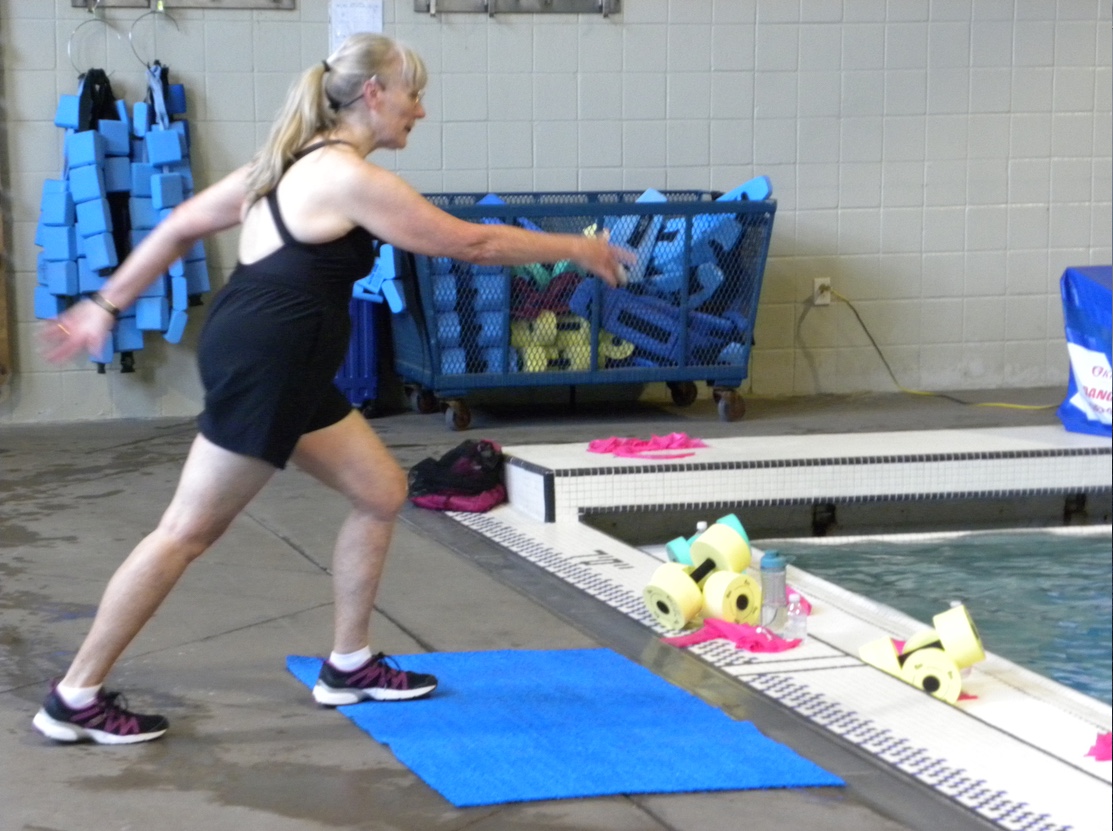
I teach a sample class on the first day. You can keep the lesson plan for your own use later on. On the second day, you teach a 5 to 8-minute sample class to give you practice cuing and demonstrating exercises. After that you can get on the sub list for the McKinney Senior Pool. Or you can get started on your certification, so that you will be qualified to teach at any facility you choose. To see a list of facilities in the Dallas area that are looking for instructors, check out the Jobs page of the website of the Metroplex Association of Aquatic Professionals at www.maapdfw.com

If this sounds like something you would like to do, you can register on the McKinney Parks and Recreation website at https://webtrac.mckinneytexas.org On the Home page click the Search button. On the drop down window click Activities. In the Type window click Aquatic Classes. The class is listed at the bottom of page 2. The cost is $60 for McKinney residents and $65 for non-residents. All materials for the class are provided. Click on the address of the pool above for a link to a map to the facility.

I hope to see you there!

IMG_4509

Chris Alexander

Training for Good Health

healthy food  The Metroplex Association of Aquatic Professionals (MAAP) offers two continuing education trainings a year. Over the years, Meridan Zerner, MS, RD, CSSD, LD, a dietician with the Cooper Institute, has been the presenter twice. I like Ms. Zerner very much because her health and nutrition advice is easy to understand and follow. I pass the information that I got from her lectures on to my classes in my Tips for the Day.

The American College of Sports Medicine (ACSM) recommends that all adults get at least 150 minutes of moderate-intensity cardiorespiratory exercise a week for good health. You could exercise at a moderate intensity 30-60 minutes a day 5 days a week, or at a vigorous intensity 20-60 minutes a day 3 days a week. In addition they recommend that you do resistance exercises 2-3 days a week and flexibility exercises (stretches) 2-3 days a week.

Ms. Zerner said that the average 50-year-old woman who weighs the same as when she was 20, requires one fourth to one third fewer calories to maintain her weight. That’s why people tend to gain weight as they age. It’s a worthy goal to not gain any more weight. To prevent weight gain, ACSM says that you should get 150-250 minutes of moderate-intensity cardiorespiratory exercise a week. That’s an extra 100 minutes of exercise per week. There are health benefits to losing as little as 10% of your body weight. If your goal is weight loss, then you have to exercise more than 250 minutes a week. And once you lose the weight, you need to continue to get more than 250 minutes of moderate intensity cardiorespiratory exercise every week to prevent the weight from coming back. If that sounds daunting, it’s because it is!

Ms. Zerner says that a better plan than exercise alone is to combine diet and exercise. If you just diet, 25% of the weight you lose will be lean muscle. If you diet and do cardiorespiratory exercise, less of the weight lost will be lean muscle. Add in some resistance exercise and you will not lose – and you may even gain – muscle mass. A good way to combine cardiorespiratory and resistance exercise is to work out in the pool, performing the exercises with power in order to take advantage of the water’s resistance.

Recent research shows that weight loss is not easy, as if we didn’t know that already. A deficit of 3500 calories does not equal a pound lost as was commonly thought. But it’s still fewer calories in than calories out. So eat less. Every meal. Drink water. Cook because then you control what goes in your food. And get exercise every day.

See you in the pool!

IMG_4509

Chris Alexander

The Benefits of Water Exercise for Your Bones

BonesIt may seem strange to talk about the benefits of water exercise for your bones. The prevailing opinion for years has been that weight bearing exercise is required to improve bone density, and since the buoyancy of the water offloads the joints, water exercise is not a good option for anyone wishing to maintain or improve their bone density. Research has been ongoing to determine if this is true or not.

Tsukahara et al. did a study in 1994, which found that participants who had done water exercise for an average of 35.2 months had bone density significantly greater than beginning exercisers or sedentary controls. The study did not prove, however, that water exercise was the reason for the results.

The prescription for osteoporosis includes both weight bearing exercise and resistance training. When researchers began to look at water exercise, not as weight bearing, but as resistance exercise, they found the reasons for the improvement in bone density in Tsukahara’s study. Bone is living tissue that continually breaks down (called resorption) and builds up (called formation). One study by Moreira et al. in 2013 concluded that performing strength training exercises in water with maximal effort and without shortening the range of motion, resulted in increased bone formation in post-menopausal women.  The water has resistance in all directions and the harder you push against it, the harder it pushes back. Performing strength training exercises in water with maximal effort is effective resistance training for building bone density. Limbs can be mindlessly floated through the water or they can be moved with power. Aim for power.

Moreira continued along the same lines in 2014, this time looking at high intensity interval training (HIIT). He divided 108 women into an aquatic exercise group or a sedentary control group.  At the end of 24 weeks, the aquatic exercise group had less resorption (15%) than the control group (29%). Only the aquatic exercise group experienced formation (15.8%). The bone mineral density of the control group decreased 1.2% whereas there was no change in the aquatic exercise group.

HIIT requires the exerciser to work hard enough to make the heart beat faster. Since heart rate slows quickly when you stand still in water, stopping to take your pulse is an ineffective way to tell how much faster your heart is beating. But there is a correlation between how fast your heart beats and how fast you are breathing. If you are working at 80% of your maximum intensity, you will not be able to carry on a conversation. You will only be able to grunt in response to a question and you can’t keep that pace for very long.  Use the same strategies for interval training that you use for strength training, a full range of motion with maximal effort. You can accelerate against the pool floor (jump), or you can accelerate against the water’s resistance in power moves. Follow the work period in your interval training with a recovery period that is long enough for you to catch your breath before you begin another work period.

Moreira’s studies duplicated the results of an earlier study done by Rotten, et al. in 2008. The findings that both strength training with maximal effort and high intensity interval training can be used to maintain bone mineral density and prevent the expected yearly decline should not be overlooked.

To learn more about the research on the benefits of immersion and water exercise, go to www.playcore.com/WaterImmersionWorks.htm To see a quick summary of the benefits of water exercise, check out the Benefits link on my website at www.waterfitnesslessons.com

See you in the pool!

IMG_4509

Chris Alexander


The Benefits of Water Exercise for Your Brain

Walk with arms to sides

It seems logical that water exercise is beneficial for your heart, but it may be surprising to hear that water exercise is also beneficial for your brain. The buoyancy of the water creates a feeling of weightlessness and most people perceive that as fun. The fun factor is why so many people enjoy working out in the water. At the end of class the feeling of weightlessness can promote a sense of relaxation. So certainly we can say the water has mental benefits.

The water also has physiological benefits for the brain. Immersion increases cardiac output throughout the entire body by relaxing the blood vessels so that they can carry more blood. With regular aquatic exercise the vessels themselves remain pliant and supple, counteracting age-related stiffening of large vessels. The working muscles are not the only beneficiaries of this improved cardiac output. The brain also benefits from increased blood flow. A recent study placed healthy subjects into a tank and measured blood flow through the major arteries that supply the brain. As the subjects were progressively immersed from zero depth to waist depth to shoulder depth, blood flow to the brain increased substantially. Blood flow increase persisted throughout the exercise period, compared to land exercise of the same intensity. This blood flow delivers more oxygen and nutrients to the brain which uses it to repair and regenerate brain and nerve cells. It is reasonable to assume that this would help slow the deterioration of age-related brain performance.

No formal studies have been published on the impact of aquatic exercise on dementia. However, there are case reports of people with Alzheimer’s disease who showed improved speech and language function, improved balance and agility, and improved cognitive and memory function not only during immersion, but even persisting afterwards. Your aquatic exercise today might just be preserving your brain function for many years into the future.

Additional research has been done on neurogenesis, or building new brain cells. Rotha Crump presented a Master Workout for the Metroplex Association of Aquatic Professionals on February 25, 2017 entitled Water Workout Wisdom. She described the brain cell building technique. First the heart rate must be elevated, although it does not need to be greatly elevated, which makes the technique perfect for the cool down portion of a water fitness class. Second the arms and legs must do something complicated – an arm movement unusual for a particular leg movement, such as cross-country ski arms with jumping jacks, or each arm performing a different movement, such as crawl stroke with the right arm and breaststroke with the left arm while jogging. Finally the participants are asked to do a mentally challenging task, such as counting or spelling backwards or making a list, out loud. It does not matter if the task is performed correctly. It is the act of doing the mental task out loud that is important. The technique has been proven to actually create new brain cells.

To learn more about this technique, check out the book Spark: The Revolutionary New Science of Exercise and the Brain by Dr. John Rately and Eric Hagerman. To learn more about the research on the benefits of immersion and water exercise, go to www.playcore.com/WaterImmersionWorks.htm To see a quick summary of the benefits of water exercise, check out the Benefits link on my website at www.waterfitnesslessons.com

See you in the pool!

IMG_4509

Chris Alexander

The Benefits of Water Exercise for Your Heart

heart rate Water exercise has many benefits, some of which were highlighted in my last Blog post. In this post I would like to focus on the benefits for your heart.

Your heart is a muscle, the most important muscle in your body. It beats 24 hours a day, 7 days a weak. Inactivity will cripple your heart! A normal resting heart rate ranges from 60-80 beats per minute. If you want to make your heart stronger, then you need to make it beat faster, which means you need to do aerobic exercise. Aerobic exercise brings the resting heart rate down. If you can lower your resting heart rate by as little as 10 beats per minute, you will be saving your heart approximately 14,400 beats in a 24-hour period.

Any aerobic exercise done on land or in the water can lower the resting heart rate. But exercising in the water has additional benefits for the heart. Just getting in the pool lowers blood pressure for most people. Blood pressure decreases because immersion relaxes the blood vessels so that they can carry more blood while presenting less resistance to the heart, which is pumping that blood. Decreased blood pressure lingers for a while after you get out of the pool. With regular aquatic exercise, the vessels themselves become more pliant and supple.

This occurs not only with healthy individuals. People with metabolic syndrome, who have a combination of cardiovascular disease risk factors, such as obesity, high blood pressure, high blood sugar, high cholesterol and high triglycerides, also tend to have stiffer blood vessels. The blood vessels become less effective in contracting and relaxing over time. In a study of 12 individuals with metabolic syndrome who participated in a deep-water exercise training program one hour a day, 3 days a week, blood vessel health improved in just 8 weeks. Obese individuals will often be more comfortable exercising in water because the buoyancy of the water supports their weight, and therefore they are more likely to continue with the program.

Blood pressure increases gradually and progressively with increasing age, resulting in a high prevalence of hypertension among older adults. Hypertension affects 3 out of 4 Americans over the age of 65. Hypertension can lead to heart attack, stroke, and other cardiovascular diseases. It is well known that land-based aerobic exercise can reduce blood pressure in patients with hypertension. A recent study confirmed that swimming at a mild to moderate intensity 3 times a week produced a clinically meaningful reduction in blood pressure in 2-3 months. This is because repeated workouts in the pool reduces stiffening of the blood vessels which is a primary factor that causes blood pressure to increase with age.

The hydrostatic pressure of the water pushes blood out to the extremities, and in combination with more supple blood vessels, stroke volume and cardiac output increases. This means that the heart becomes more efficient, pumping more blood with each stroke. Blood flow to the muscles during water exercise can increase an amazing 250%. Blood flow to the brain also increases, delivering more oxygen and nutrients to the brain cells. With this kind of blood flow, heart rate is lowered. Target heart rates while exercising in shallow water average about 7 beats per minute lower than the same intensity exercise on land. Target heart rates in deep water, where more of the body experiences the hydrostatic pressure of the water, average about 17 beats per minute lower than the same intensity exercise on land. The exact number of beats per minute depends on many factors, including the fitness level of the individual.

If you have chest pains while working out in the pool you need to stay in the water because the heart rate will go up when you exit the pool. Instead, alert the lifeguard so that he or she can assist you and initiate the emergency action plan if necessary.

Working out in the water has many benefits. The benefits for the heart include making the heart stronger, decreasing the resting heart rate, making blood vessels more supple, reducing blood pressure, and increasing stroke volume. If you would like to see summaries of the research on the benefits of water exercise on the heart or on any of the other benefits of immersion and water exercise, go to www.playcore.com/WaterImmersionWorks.html

See you in the pool!

IMG_4509

Chris Alexander