The question of whether water exercise can help improve bone mineral density has been a subject of research for at least two decades. The question arises because the buoyancy of the water decreases the effects of gravity and reduces weight bearing. A body immersed to the waist bears about 50% of its body weight. A body immersed to the chest bears approximately 25%-35% of its body weight. A body immersed to the neck bears about 10% of its body weight (Aquatic Exercise Association, Aquatic Fitness Professional Manual). Therefore, since water exercise is not effective weight bearing exercise, then it been dismissed as unlikely to be beneficial for people with osteoporosis. The problem with this line of reasoning is that it fails to take into account the other recommendation that people with low bone density also engage in strength training exercise. Bone remodeling is stimulated by muscle contractions and moderate skeletal loading. The aquatic environment provides resistance in all directions, promoting muscle strengthening and muscle balance. Leader Tools, an AEA publication for instructors who teach arthritis classes, notes that “In a systematic review and meta-analysis, Schinzel and colleagues (2023) reported statistically significant improvements in bone mineral density at key skeletal sites (both the lumbar spine and femoral neck).” Even with reduced joint loading, muscle activation and moderate skeletal stress still occur, helping to maintain and even improve bone density.
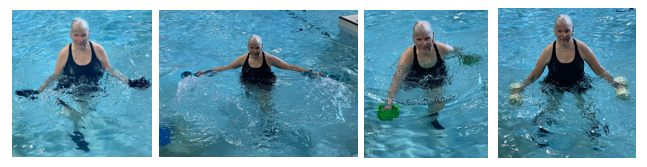
Low impact does not mean low intensity. One of the most effective ways to overload the muscles is to use acceleration, that is to push against the water’s resistance with force. Be intentional about it. Stabilize your core in good alignment, then move any upper or lower body joint through its full range of motion in any plane – sagittal, frontal or transverse – or in diagonals, pushing hard. Add more resistance with equipment. Drag equipment, such as webbed gloves, paddles and drag bells provide resistance in every direction. Foam dumbbells offer resistance, but mainly toward the pool floor. Click on the links for brief video demonstrations of each piece of equipment. Avoid exercises that cause spinal compression which may lead to fractures, such as crunches, waist twists and lateral flexion (or limit the range of motion).
It is important to note that it takes 6 months of consistent exercise to start seeing benefits. Being consistent and committed to a physical activity regimen contributes to bone health. The American College of Sports Medicine recommends at least 150 minutes of moderate exercise each week, and two or more sessions of strength training. You might wish to include other forms of exercise in your regimen, such as walking or strength training on land, both for variety and to meet these exercise recommendations.

If you have osteoporosis, a good resource for information is the Bone Buddies Osteoporosis Support Group. The General Programming page describes their programs, which include free exercise classes, monthly presentations on topics pertaining to osteoporosis, healthy eating sessions with a registered dietician, ask the pharmacist sessions, and sessions with a psychology educator. The exercise classes include tips on how to perform daily tasks without risking a fracture. All of the programs are on Zoom, so you can tune in from anywhere in the country. The Resources page includes links to Michael Lavacot’s very educational YouTube videos explaining osteoporosis and comparing medications, among other resources. The Events page has the Calendar with the dates of all the individual programs for the next year.
One of the risks for osteoporosis is age, and none of us can avoid that. It makes sense to remain active throughout your lifetime to minimize the risks and manage your low bone density if it occurs. See you in the pool!

Chris Alexander
One response to “Water Exercise and Osteoporosis”
-
Hi
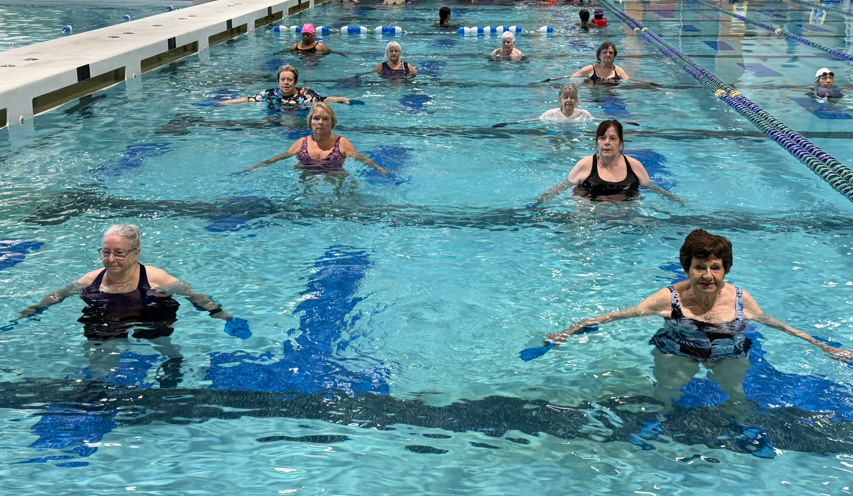
Good pictures of us doing aerobics with the paddles.
You are a great instructor. I get a really good work out.
Thanks

Leave a Reply