
Once you get your Medicare card your doctor will start asking if you have fallen in the past 6 months. And with good reason. Over 14 million, or one in four, older adults report falling every year, according to the CDC. Falls are the leading cause of injury and death among adults 65 and older. But falls are preventable. Here are 3 things you can do to improve your balance:
- Understand your body’s balance systems
- Practice seated stability
- Practice standing balance
Understand your body’s balance systems. Your ability to maintain balance depends on three sensory systems, the visual system, the vestibular system, and the proprioceptive system. The visual system is your eyes telling you where you are in relation to your environment. The vestibular system is located in your inner ears, and it tells your brain about your head’s position in three-dimensional space. The proprioceptive system consists of specialized receptors throughout your body, and they detect what your muscles and joints are doing and sense pressure in the soles of your feet. When any of these systems are compromised, the other systems must take up the slack.
Practice seated stability. Improving your balance starts with sitting in neutral. Sit on a chair with feet flat on the floor, hip-width apart. Tilt your pelvis forward and back to find neutral. Tilt your pelvis side to side to find neutral. Place your hands on the side of your waist and your tongue behind the top front teeth. Inhale and exhale slowly, feeling your belly expand and then draw upward. This is diaphragmatic breathing. It improves core stability. You want to be able to hold this neutral position for up to 90 seconds at a time. Next shift your weight to your sitting bone on one side and hold for a few seconds,. Return to center, then shift to the other side. Shift your weight forward, leaning from your hips, and hold for a few seconds. Return to center then lean backward. Practice reaching one arm forward, to the side, straight overhead, and across the midline, all with minimal trunk movement. Closing your eyes, lifting one foot, swinging your arms, turning your head, and extending one leg are all challenges for seated stability. Try doing these challenges in the pool, seated on a noodle like a swing.
Practice standing balance. Stand facing a counter, feet shoulder width apart with weight evenly distributed on both feet, your knees slightly bent, your spine in neutral, and your gaze looking forward at eye level. Stand with both hands lightly touching the counter. Progress to fingertips barely touching, one hand touching, fingertips on one hand touching, then finally hands hovering near the counter. When you can do that, practice standing away from the counter, but near enough for safety, with feet hip-width apart. Progress to feet together with inner ankles touching, then a semi-tandem stance with one heel beside the arch of the opposite foot, and finally a tandem stance with the back foot’s toes touching the heel of the front foot. The goal is to hold the position for 20-30 seconds without losing balance. The next stage is single-leg standing. Stand beside a counter with both hands touching the counter and lift one foot 2-3 inches off the ground. Progress to standing on one foot with one hand on the counter, then one finger touching the counter, and finally no support. Train your balance systems by closing your eyes, tilting your head or balancing on varied surfaces, such as foam, grass or carpet. Take your balance practice to the pool, where buoyancy reduces fear of falling, viscosity slows movement for better control, and turbulence creates continuous balance challenges. Stand in the previous foot positions near the pool wall. Progress to standing on one foot with the eyes closed, then walking with high knees, heel-to-toe, in multiple directions, and backward. Practice weight shifting, reaching in multiple directions, and reaching while standing on one leg.
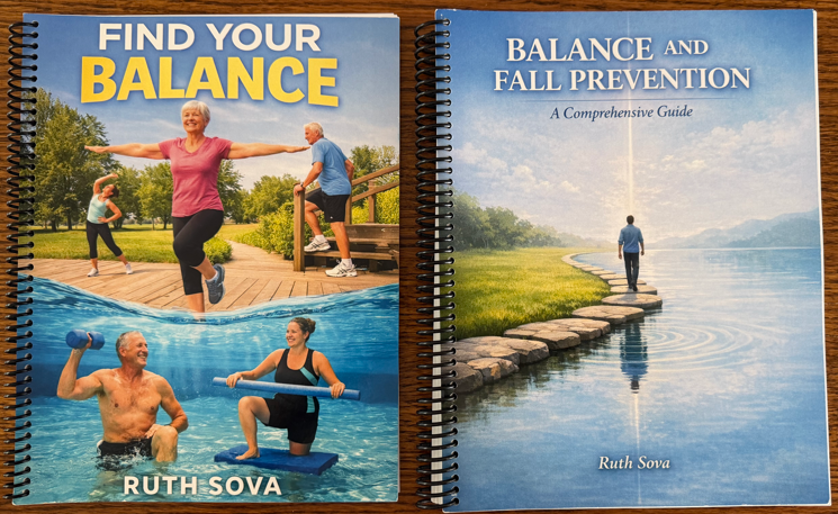
Your ability to stand on one foot for 10 seconds is a snapshot of your body’s integrated health. If you are unable to do so, you are at 84% risk of death from any cause over the next 7 years. The good news is that balance is trainable at any age. This article only skims the surface of what to do to improve your balance. Start where you are now and progress from there. For more information see Ruth Sova’s books Find Your Balance for individuals, or Balance and Fall Prevention for aquatic professionals.
See you in the pool, practicing balance!

Chris Alexander
Leave a Reply