
If you start to fall, you have only milliseconds to react. Will your ankle muscles contract to correct your balance? Will your hip muscles contract to shift your center of gravity to neutral? Will you take rapid steps in the direction of the fall? As you get older, you may notice that you are a little slower to react than you once were. Slower reaction time increases your risk of falling. The good news is that it’s never too late to improve your reaction time. Two things you can do are: train for power, and practice reacting to an unpredictable command.
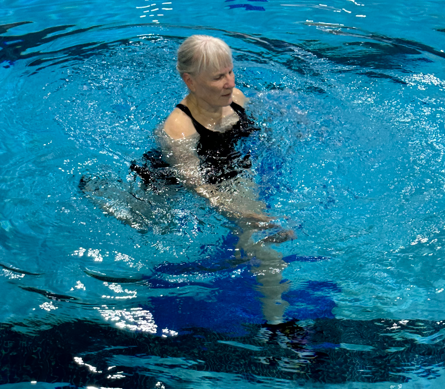
Train for Power. As we get older we lose power faster than we lose strength. Strength and power are not the same thing. Strength is how much force your muscles can produce; strength is lifting a heavy bag of groceries out of the trunk. Power is how quickly you can produce force; power is catching yourself when you trip, or stepping off a curb in time. Fast twitch muscle fibers are responsible for quick, powerful movement. With age, these are the first to be lost unless we give the body a reason to hold on to them. When you move with real effort or with speed in your water fitness class, you are calling on those fast, powerful muscle fibers. It may be tempting to take it easy in class, going through the motions while chatting with your neighbor. But if you want to strengthen those fast twitch muscles so that you can react to a potential fall situation, you need to push yourself. If you only cruise along comfortably, those powerful fibers are never called into action, and you slowly lose them. The beauty of water is that the faster you push against it, the more it pushes back, so it challenges you exactly as hard as you choose to work, and never any harder. Ease off and the resistance melts away instantly. Because the water supports your body, you can put real effort into your movement without jarring your joints. You can train for power with confidence. Pushing yourself means you are working, breathing a little harder, muscles engaged. Think short bursts of effort, then ease off and recover (intervals). You are moving with purpose and a little speed, not comfortably cruising or just going through the motions. Click on Cross-Country Ski for a short video that demonstrates pushing against the water by increasing range of motion, increasing speed, adding elevation, adding power, or adding rotation. Each variable is performed in deep water for 4 counts.
Practice Reacting to an Unpredictable Command. You need your instructor to help with this one. Events that lead to a fall are not predictable. In your water fitness class your instructor normally lets you know what is coming and gives you time to switch to the next exercise. Usually you perform that exercise for a sufficient amount of time so that you feel comfortable with it. When your instructor uses the Unpredictable Command technique, the movements are atypical and the change to the next move is rapid fire. When I use the technique, I do not have a specific script, but instead I make it up on the spot, so that it is always unpredictable. A sequence might look something like this: knee lift with the right leg, push the left hand forward, put the right hand on your hip, push the left hand forward and side, look over your right shoulder, press your palms together and look forward, jog with both feet, turn to your left, take 3 steps left and one step right, swing the left leg forward and back while making fists and stretching the fingers, make a fist with one hand and stretch the fingers with the opposite hand, go into a cross-country ski and clap one hand at a time, turn to your right and travel backward. You get the idea. Physical activity that combines movement with decision-making and coordination, requires balance, timing, and problem-solving. It challenges both the body and the brain simultaneously. So the next time you are in a crowd and someone steps in front of you unexpectedly, or you are walking the dog and he decides to chase after that squirrel, or you stub your toe on a change in elevation in the sidewalk, your reaction time may be just a little quicker.
See you in the pool!

Chris Alexander
Resources: Marietta Mehanni, “Why It Pays to Push Yourself,” 2026. David Ogden, The Unpredictable Command Technique, 2001. Ruth Sova, “Never Too Old to Train the Brain,” 2026, Ruth Sova, Balance and Fall Prevention, 2026.
Leave a Reply