New Exercises for a New Year

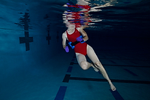
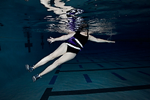
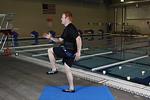
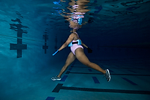
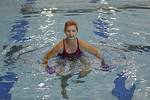
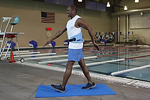
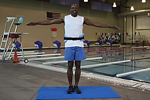
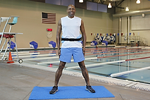
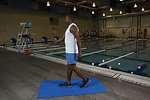
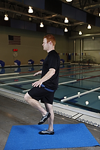
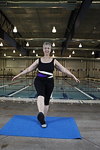
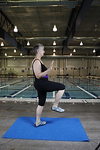
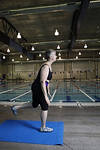
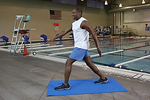
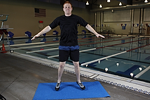
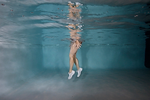
Adam deep water jog   Adam straddle jog   Amos heel jog

Can you believe that 2016 is here already? Perhaps your class took a break for the holidays, but now it is time to get back into your routine. Freshen up that routine with some new variations on one of the basic exercises for shallow water.

Variations were described in my last Blog post. This time I’d like to apply those variations to a specific exercise: the knee high jog. Before adding any variations though, make sure that you are jogging with good form. The spine is in neutral, the core is braced so that the shoulders are stationary and the head is not rocking from side to side, and the thighs are coming up no higher than parallel to the floor.

If you open up the hips, the knee high jog becomes a straddle jog. If you lift your heels instead of your knees, it becomes a heel jog.

Now change the arm moves. Try an arm swing, a lat pull-down, a shoulder sweep, a shoulder blade squeeze, a row, an arm curl, a triceps extension, or a rotator cuff sweep. The arm swing can be done with unison arms, the lat pull-down with alternating arms and the shoulder sweep can become a breaststroke or reverse breaststroke. Slice the hands or make the palms face the direction of motion. Put one hand on the hip and perform the arm move with a single arm. Add pulses. Combine moves, for example a lat pull-down and a shoulder sweep. Or jog with hands on hips, arms floating near the surface of the water, or sculling.

Vary the tempo. Water tempo jogging can easily be sped up to land tempo without losing range of motion. With a half water tempo you will bounce on both feet, lift one knee (or heel), bounce on both feet and lift the other knee (or heel). Pauses can be added to challenge balance. For example, “single, single, hold” means lifting the R knee, L knee, R knee and hold for 2 counts. With doubles you lift each knee 2 times. “Single, single, double” means R knee, L knee, R knee, R knee. Syncopate is 2 counts at water tempo and 3 counts at land tempo, sometimes described as slow, slow, quick quick quick.

Knee high jog, straddle jog and heel jog can all be done with rebounding. Perform the knee high jog in the neutral position by flexing the knees and hips to submerge the body to shoulder depth. A straddle jog in neutral becomes a frog jump. A heel jog becomes a seated hamstring curl. A suspended jog is a seated leg press with hands sculling or you can do a suspended bicycle instead. Frog jumps become suspended frogs. Seated hamstring curls can be done without touching the floor. All 3 types of jogs can be done grounded. One foot stays on the floor and the other knee is lifted in front or to the side or the heel is lifted in back. Try doing 1-4 R knee lifts, R side lifts, R heel lifts, then switch to the L leg.

Increase the range of motion by taking the feet wider apart. Knee high jog and straddle jog become run tires (like running through tires in football practice) or you can leap forward or sideways. Heel jog can be done with the feet apart or turn the short lever into a long lever and do a skate kick. Cross the mid-line of the body with crossover knees or an inner thigh lift or a hopscotch.

Power can be added to any of these moves. So can turns and traveling in multiple directions.

Some of the most interesting variations are created by combining 2 or more moves. In, in, out, out is a combination of knee high jog and run tires. Combine in, in, out, out with 2 jacks or with one inner thigh lift or with one hopscotch. Chorus line kick is one knee lift and one kick. Do 3 straddle jogs and one side quad kick. Or 3 heel jogs and one kick to the corner. Try more complex combinations such as R knee lift, L knee lift, L quad kick, L lunge. The lunge goes into a L knee lift and the sequence repeats. Use your creativity and you will be able come up with your own new combinations.

What Exercises Can You Do in Deep Water?

Can you do the same exercises in deep water that you can do in shallow water? You can do some of them, but not all, and there are some exercises that you can do in deep water that you can’t do in shallow. When you are building your exercise library for deep water, remember that there are only a few basic exercises and all other exercises are variations of these.

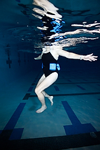
The basic exercises in deep water are jog, bicycle, kick, cross-country ski and jumping jacks. If you do the jumping jacks with the arms and legs opposite, as shown in the start and finish photos, then you will not bob up and down.

Just as in shallow water, there are many ways to vary these 5 exercises.

  1. Use different arm movements.  Try arm swing (shoulder flexion and extension), lat pull-down (shoulder abduction and adduction), shoulder sweep (horizontal shoulder abduction and adduction), arm curls (elbow flexion and extension), or rotator cuff sweep (shoulder external and internal rotation).  Use alternating arms or both arms in unison. If you use one arm, or no arms, you will challenge your core muscles, because it will be harder to maintain neutral posture.
  2. Vary the tempo. The speed at which exercises are performed in deep water is slower than in shallow water because the range of motion is greater. But you can still vary the tempo with pauses (single, single, hold) or syncopate (slow, slow, quick, quick, quick). You can also increase the speed, especially with smaller moves such as flutter kick, mini ski and mini jacks.
  3. Change the working position. Exercises can be performed upright, at a diagonal angle, side-lying, or seated. Use a scull to lift the shoulders out of the water.
  4. Increase the range of motion. Exercises can be performed with larger arm or leg movements, or the feet farther apart, or you can cross the midline of the body.
  5. Add acceleration or power, by pushing harder against the resistance of the water. If you accelerate toward center in what is sometimes called a power pop, you can lift and lower the shoulders in and out of the water in a very high intensity move.
  6. Add turns. You can do quarter turns, half turns, or full turns. Diagonal turns are quarter turns toward the right corner, then toward the left corner.
  7. Travel. You can travel forward, backward, and sideways. Although you can travel using leg motions only, most travel in deep water depends on arm movements. If you lean diagonally toward the side, you will travel sideways. If you are in a side-lying position, it will be the leg movements that propel you sideways. You can travel in patterns, such as a diagonal line, circle, square, bow-tie pattern, zig-zag, or scatter pattern.
  8. Combine exercises. Putting two or more exercises together creates a new exercise. Examples include log jump right, jacks tuck, log jump left; quad kick front and side; tuck ski and jacks tuck alternate; and cross-country ski side-lying right, tuck, pike, tuck, cross-country ski side-lying left.

Not every variation will work with every exercise. But using even a few variations will increase your exercise library tremendously.

Note: the photos are from my book, Water Fitness lesson Plans and Choreography. For more information on the book, check out my website at www.waterfitnesslessons.com
What Exercises Can You Do in the Pool?

Whether you are exercising on your own in the pool, or you are a water fitness instructor getting ready to teach a class, you need to have a collection of exercises you can use. You want exercises that are fun, and you probably want some of them to raise your heart rate into your target zone.  Building an exercise library can seem like a daunting task.

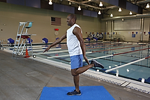
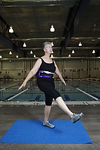
It helps to remember that there are only a few basic exercises and all other exercises are variations of these.  The basic exercises in shallow water are walk, jog, kick, rocking horse (shown as starting position and finish), cross-country ski, jumping jacks and jump.

Now how do you create variations of these exercises?

  1.  Use different arm movements. Try arm swing (should flexion and extension), lat pull-down (shoulder abduction and adduction), shoulder sweep (horizontal shoulder abduction and adduction), arm curls (elbow flexion and extension), or rotator cuff sweep (shoulder external and internal rotation). Use only one arm, use both arms in unison, use alternating arms, or no arms.
  2. Vary the tempo.  Water tempo is the normal speed used in water. Land tempo is faster, but you want to be sure not to lose your range of motion. Half water tempo adds a bounce on every other beat. You can also add variations in tempo such as pauses, doubles, and syncopate. An example of a pause is single, single, hold. Single, single, double means one right, one left, two right, and so on. Syncopate means slow, slow, quick quick, quick.
  3. Change the working position, also called the impact option.  Exercises can be performed upright with some rebounding, in the neutral position with the hips and knees flexed to submerge the body to shoulder depth, suspended with the feet not touching the floor, and grounded or keeping one foot on the floor at all times.
  4. Increase the range of motion. Exercises can be performed with larger arm or leg movements, or the feet farther apart, or you can cross the mid-line of the body.
  5. Add acceleration or power, by pushing harder against the resistance of the water.
  6. Add turns. You can do quarter turns, half turns, or full turns. Diagonal turns are quarter turns toward the right corner, then toward the left corner.
  7. Travel. You can travel forward, backward, sideways, or on a diagonal. If you are traveling on a diagonal you do not face the direction of travel, which would be the same thing as traveling forward, but rather you continue to face forward while traveling toward a corner. You can travel in patterns, such as in a circle, square, bow-tie pattern, zig-zag, or scatter pattern.
  8. Combine exercises. Putting two or more exercises together creates a new exercise. Examples include the chorus line kick (which is one knee lift and one kick), quad kick front and side, jumping jacks squat, and ski-ski-kick-and-lunge.

Not every variation will work with every exercise. But using even a few variations will increase your exercise library tremendously.

Note: the photos are from my book, Water Fitness Lesson Plans and Choreography. For more information on the book, check out my website at www.waterfitnesslessons.com
Water Fitness Instructors Needed

Water fitness instructor class

Do you like being active? Do you enjoy the water? Do you like helping people? Are you interested in being a water fitness instructor?

There is a shortage of water fitness instructors in the Dallas-Fort Worth area. Check out the Job Postings on the website of the Metroplex Association of Aquatic Professionals at www.maapdfw.com to see how many facilities are looking for instructors. So how do you go about becoming a water fitness instructor? I’m glad you asked! You can sign up for my class coming up in October.

Beginning Water Fitness Instructor Class

Saturday October 3 and Saturday October 10 – Participants attend both days

Time: 10:00 am to 2:30 pm

Cost: $60 for residents of McKinney, $65 for non-residents

Location: McKinney Senior Pool, 1400 S. College Street, McKinney, TX 75069

To register, go to https://webtrac.mckinneytexas.org or stop by the pool and register in person or call 972-547-7495 for assistance.

The class gives basic information necessary to teach a water fitness class.

Bones & muscles     Heart rate    pool water    Aquatic equipment

Some of the things you will learn are:

  • The names of the muscles and how they work during exercise
  • How to increase and decrease intensity so that you achieve your target heart rate
  • The properties of water and how to manipulate them during a water fitness class
  • How to use various kinds of equipment

The class is ideal for people who want some idea of what they have to learn before they sign up to take a certification test, for people who have lots of questions, and for people who do better with hands on experience than with just reading a book.  The next step is to sign up to get a certification. A good entry level certification is offered by the United States Water Fitness Association (USWFA). You do not have to take my Beginning Water Fitness Instructor course in order to get their certification. If you have some fitness experience and don’t feel like you need any additional training, you can contact the USWFA directly at www.uswfa.org. The cost for a certification is $247. They will send you a water fitness instructor manual, an open book test, and some forms to fill out, which you will bring to a National Testing Day (NTD). At the NTD you take a closed book test and teach an 8-minute sample class. The instructor-trainer tells you at the end of the day whether you passed. After that, you can contact some of those facilities looking for instructors and get your own class.

See you in the pool!

How to Train for Good Posture

You can’t really be physically fit if you don’t have good posture. Therefore you have made a commitment to train for good posture in your water fitness class. Great! This may require you to rethink how you perform the exercises. You will need to be sure to keep your sternum lifted, your shoulders level, and your core braced so that you maintain your good posture no matter what exercise you are doing. Sometimes in your eagerness to increase intensity and burn calories you may inadvertently take your spine out of neutral alignment. Let’s take a look at some common exercises and see how this happens.  All of the photos show the exercises performed with bad form.

High knee jog

Knee High Jog.  This is a great exercise for increasing the heart rate and burning calories. But sometimes in your enthusiasm to increase intensity you may bring the knees too high, as in this picture, putting pressure on the low back and possibly aggravating the sciatic nerve. Bring the knees up just until the upper leg is parallel to the floor.


Leaning inner thigh lift

Inner Thigh Lift.  This exercise improves hip flexibility because you are moving the leg in a diagonal plane. You might decide to increase your range of motion by touching your ankle with your opposite hand. But if you have to bend forward to reach the ankle, as in this picture, you are taking your spine out of neutral. Better to touch the inner thigh or knee instead.


Leaning hopscotch

Hopscotch.  This exercise works the hamstrings. It is more important to maintain neutral alignment than to actually touch the heel with your opposite hand. If you have to bend to the side to reach the heel, as in this picture, then it is better to just swipe at the heel with your hand.


Too high kick

High Kick.  This is a long lever exercise so it takes more effort and burns more calories than its short lever cousin, the knee high jog. The goal here is not to get the foot out of the water though. If you find yourself leaning backward to get the leg higher, as in this picture, you are bringing the leg too high and taking the spine out of neutral.


Arching rocking horse

Rocking Horse.  This exercise works multiple leg muscles and also challenges balance because it takes the body off-axis. Watch out for an overly enthusiastic rocking motion though. Arching the back while shifting the weight to the back leg, as in this picture, puts a lot of stress on the low back.


Greater intensity levels can be achieved when the exercises are performed with good posture and the power is put into the arm and leg movements. You might be surprised at how hard you can work while keeping the sternum lifted, the shoulders level and the core braced.  See you in the pool!