Free Choreography #1

IMG_4483

The term choreography calls to mind dancers performing on a stage or in a music video. So using the term for a water fitness class may seem intimidating. But it does not have to be complicated. Basically, choreography is your lesson plan. Writing choreography involves taking your list of exercises and organizing them in the order in which you plan to teach them. Your class will be more successful if you make a plan ahead of time so that you don’t find yourself struggling to come up with exercises to fill the time.

To help you remember your choreography you need to organize the exercises in a way that is logical to you. There are a variety of choreography styles that can be used to help you do this. The simplest is linear choreography. Linear choreography organizes the exercises in a “line,” that is, without patterns or repetitions.

The following is an example of linear choreography for a shallow-water class using just 6 basic exercises with variations. The 6 exercises are:

  1. Knee-high jog
  2. Run tires (like running through tires at football practice)
  3. Jumping jacks
  4. Cross-country ski
  5. Kick forward
  6. Heel jog

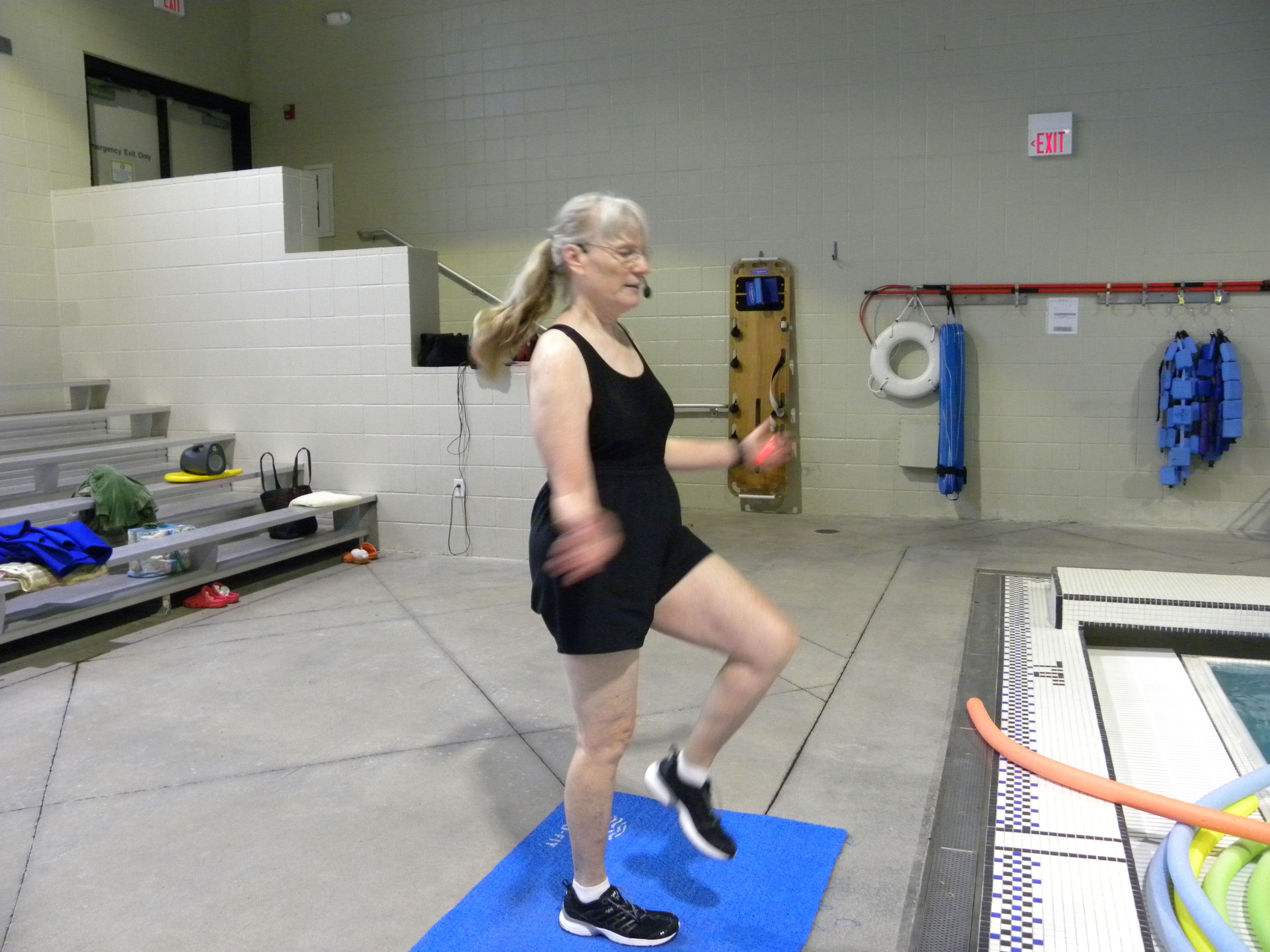
The logic of using the exercises in this order is that it is easy to transition from one to the next. From the knee-high jog you move the legs farther apart to go into running tires. Next you bounce center and apart in jumping jacks. From the center bounce you transition into cross-country ski. Stay in the sagittal plane to go into a kick forward. Finally switch the leg movement from front to back in a heel jog.

Breaking up the choreography into sets divides it into sections that are easier to remember than a long chain of exercises. In this case each set will feature one of the six exercises.

  • (A set)
  • Knee-high jog with jog press
  • Knee-high jog with pumping arms
  • Knee-high jog faster & slower alternate
  • Leap forward
  • (B set)
  • Run tires with scull
  • Run tires with shoulder blade squeeze
  • Run tires with rebound & neutral position alternate
  • Leap sideways
  • (C set)
  • Jumping jacks
  • Jumping jacks clap hands
  • Jumping jacks neutral position & suspended alternate
  • Jumping jacks 4X with 1/4 turn
  • (D set)
  • Cross-country ski
  • Cross-country ski with windshield wiper arms
  • Cross-country ski & cross-country ski with power alternate
  • Cross-country ski 3-1/2X & 1/2 turn
  • (E set)
  • Kick forward push forward
  • Kick forward with triceps extension
  • Kick forward low & high alternate
  • Kick forward travel backward in a circle
  • (F set)
  • Heel jog with paddlewheel
  • Heel jog with forearm press
  • Heel jog & hopscotch alternate
  • Skip rope travel forward in a circle

This should take approximately 20 minutes. Repeat the choreography a second time. Add a 5-minute warm at the beginning, 10 minutes of noodle exercises afterwards, and 5-minutes of stretching and you have a 1-hour lesson plan ready to go.

For more examples of linear choreography, see my book Water Fitness Lesson Plans and Choreography. A link to purchase the book from Human Kinetics can be found on my website at www.waterfitnesslessons.com

Next Blog post: Pyramid Choreography.

See you in the pool!

IMG_4509


Exercise to Music

DSCN0422    It’s fun to exercise to music! Music is a great motivator. It helps you maintain a cadence so that you stay on track and achieve the desired intensity. It also makes the workout seem to go faster.


If you are working out in the gym, you can plug your headphones into your iPod and use whatever playlist you like. If you are exercising in your backyard pool, you can turn on your sound system and play your favorite musical artist. It’s not that simple if you are teaching a water fitness class. Copyright laws state that musicians have the right to charge a fee for the use of their music in public performance, and a water fitness class is considered a public performance.

ASCAP (American Society of Composers, Authors, and Publishers) and BMI (Broadcast Music Incorporated) are the two largest companies worldwide that offer services to enable fitness professionals to access and use music without needing to contact each artist individually. Facilities that offer fitness classes must pay the appropriate ASCAP or BMI fees. Instructors should buy their music from companies that pay appropriate reproduction fees to produce CDs and music downloads for fitness applications. Some of these music companies are:

Dynamix  www.dynamixmusic.com

Muscle Mixes   www.musclemixes.com

Power Music     www.powermusic.com

Yes Fitness Music     www.yesfitnessmusic.com

Music can be purchased as CDs or downloads. A variety of titles are available or you can create your own playlists. For a shallow-water class, 125-150 beats per minute (BPM) is recommended. I personally like 130-140 BPM for my shallow-water classes. In deep-water classes, the drag forces of the water and increased range of motion require a slower cadence. 100-135 BPM is recommended, which is typical of music created for step classes. I like 126-128 BPM for my deep-water classes.

If you are playing a CD, you need a battery operated CD player or one plugged into an electrical outlet installed with Ground Fault Interrupters (GFIs). Do not adjust any knobs on the CD player with wet hands. Most CDs play 45 minutes or an hour. If your CD is 45 minutes and your class is an hour long and you are teaching in the water, either teach the last 15 minutes without music, or dry your hands very carefully before re-starting the CD. If you are teaching from the deck, this is not a problem.

If you downloaded a playlist to your iPod or MP3, you will need some type of speaker to plug it into. Again, you do not want to handle the equipment with wet hands. With a download, you can make the playlist the exact length of your class. You can even add cool down music for the stretches at the end of class. Apps are available that can adjust the tempo of your music so that you can play your download at 130 BPM for strength training with equipment one day, and 140 BPM for cardio another day. Be sure to listen to the music at the lower or faster speeds to make sure the voices don’t sound either draggy or like chipmunks.

If you choreograph your moves to specific songs, then you will use that playlist for that lesson plan every time you teach it. I prefer to create lesson plans that work with any of my playlists. Having a variety of lesson plans and a variety of playlists allows you to mix and match and change things around often. Variety is the spice of life!

See you in the pool!

IMG_4509


Exercises for Balance

Every 14 seconds an older adult is treated in the emergency room for a fall. Every 29 minutes an older adult dies from a fall related injury. Fear of falling often causes an individual to shorten his/her stride, shuffle the feet, and bend forward to see where the feet are. Ironically, this increases the risk of falling.

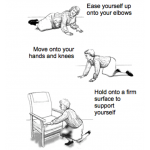
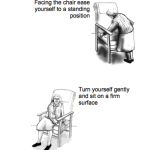
It is important to know how to recover from a fall. First, ease yourself up onto your elbows. Move onto your hands and knees. Then hold onto a firm surface, such as a chair, to support yourself. Facing the chair ease yourself to a standing position. Turn yourself around and sit on the chair.

Balance is the ability to distribute your weight in a way that enables you to hold a steady position or move at will without falling. It is possible to improve balance with exercise, and in fact, balance training is one of the top 10 worldwide trends in the fitness industry. The pool is the perfect place to work on balance. Because the water’s buoyancy and resistance helps support the body, exercises can be done without fear of falling.

There are a number of strategies for improving balance. Some of them are:

  1. Gait Training. Gait training is walking practice with the goal of lengthening the stride and improving confidence while walking.
  2. Core Strength Training. The goal of core strength training is to improve the strength of the postural muscles of the trunk.
  3. Deep-Water Exercise. Deep water exercise is performed, while wearing a flotation device, in water in which a person can remain vertical without the feet touching the floor. Exercisers must aggressively engage the stabilizing muscles of the core to remain upright.
  4. Unpredictable Commands. Unpredictable commands train the body, and in particular the core muscles, to react to the unexpected.
  5. Balance Challenges. Balance challenges are performed with a narrow base of support, such as the feet together, one foot in front of the other or standing on one foot.

For specific exercises using each of these 5 strategies, you are invited to attend my lecture, Exercises for Balance, at the Bone Buddies osteoporosis support group on Saturday, May 14 at 9:45 AM. The meeting is free and open to the public. The location is the Methodist Richardson Medical Center, 2821 George Bush Hwy. Suite 200, Richardson, TX 75082.

Whether you wish to work on improving your own balance or you are an instructor interested in adding balance training to your water fitness class, there lots of exercises to choose from. I hope you’ll join us.

See you in the pool!

IMG_4509

Now What?

My last 4 blog postings have been about building your exercise library. And if you are exercising in the pool on your own or teaching a water fitness class, it is important to build your exercise library. But how do you put it all together into a workout? You could just get in the pool and start doing whatever exercise comes to mind. Would there be a problem with doing the deep water exercises in the order of the pictures below?

The exercises are jumping jacks, jog with a diagonal lean, side to side extension, knee high jog, lateral flexion, power run, cross-country ski, and jog with elevation. All of these are good exercises, but would you want to do them in this order? Of course not! But why not? You would be asking your body to jump right into cardio, drop down into core work, go back into cardio, stretch, go into high intensity cardio, and then you’re done.

It would be much better for your body to give it time to work up to higher intensities and then let it come down gradually. That’s why a good workout has 4 distinctive parts:

  1. The warm up. When you first get into the pool, the water feels cold. That’s because the pool temperature is perhaps 15 degrees cooler than body temperature. You need to acclimate to the environment of the water, warm up the muscles, and increase the metabolic rate in order to be ready for your workout. Start with a vigorous short-lever exercise, such as a knee-high jog. Then add long lever exercises, such as a jumping jack. The warm-up should last from 5-10 minutes.
  2. The conditioning phase. This is the main part of your workout. If your goal is cardiorespiratory endurance, then you want to do exercises that get your heart rate up. Cross-country ski is the perfect exercise for this! You can also increase intensity by adding acceleration, (as in the power run) or elevation. Your conditioning phase lasts 20-50 minutes, depending on how long your want your workout to be or how long your class is.
  3. The cool down.  You need your heart rate to return to its resting state. So you will start to slow down by using lower intensity exercises. The jog with a diagonal lean is a good transitional exercise. It is less vigorous than a power run and it adds in a core challenge to maintain alignment. When the heart rate has come down, you can do toning exercises or core exercises, such as the side to side extension. The cool down lasts 5-15 minutes.
  4. The post stretch. The best time to work on flexibility is now, when the muscles are still warm. Lengthen a muscle and then hold it in a static stretch. Or move the joints through their full range of motion in a dynamic stretch. Aim to stretch for at least 5 minutes.

It may take some planning to put together a workout that is not just a random set of exercises, but your body will thank you.  I’ll bet you can rearrange those pictures above into a better order now.

IMG_4509

See you in the pool!

Chris Alexander

For more information about organizing workouts, see my book, Water Fitness Lesson Plans and Choreography. You can find out how to order it on my website at www.waterfitnesslessons.com

The Perfect Water Fitness Exercise

Johnnene CC Ski

If I had to pick a favorite exercise, hands down it would be cross-country ski. It’s the perfect exercise! The basic ski is a long lever exercise, so it can be used for both high intensity and improved range of motion. And there are multiple variations. Cross-country ski can be used in both shallow water and deep water. Let’s look at some of the possible variations of the deep water ski.

But first, check to make sure you are performing the ski correctly. You want full hip flexion and hyperextension, as much as your body will permit comfortably, so be sure not to limit the range of motion to forward flexion, or your ski becomes a kick forward. You can check to see how much hyperextension you are getting by doing your cross-country ski with your back to the pool wall. How close do you have to get to the wall before your back heel taps the wall?

Cross-country ski can be changed to a short lever move by keeping the knees bent at 90 degrees when decreased intensity is desired. Tuck ski is another less intense variation. In tuck ski together, you tuck your feet under your body, go into your ski position with one hip flexed and the other hyperextended, then pull both straight legs to center. A mini ski is smaller than a cross-country ski but bigger than a flutter kick.

The basic arm movement is shoulder flexion and hyperextension. Aim for full range of motion. The hands can slice through the water, or you can increase intensity by making the palms face the direction of motion. Try other arm movements, such as lat pull-down (shoulder adduction and abduction), shoulder sweep (horizontal adduction and abduction), arm curls (elbow flexion and extension), or rotator cuff sweep (shoulder external and internal rotation). Use alternating arms or arms in unison, or use just one arm and put the other hand on your hip or behind your back. One-arm moves challenge the core muscles.

The working positions for cross-country ski are upright, diagonal and side-lying. Tuck ski together can also be performed side-lying.

There are many ways to increase intensity with cross-country ski. Increasing the speed of a long lever move like cross-country ski without decreasing the range of motion is a challenge. It is easier to increase speed with a mini ski. Increase the range of motion and the intensity by making your ski bigger in what is sometimes called an over stride. Skiing with rotation, in which the arms reach across the midline of the body, also increases the range of motion. Tuck ski can be performed with rotation too. Try the helicopter ski, in which the arms and legs sweep around the body in semicircles instead of the usual flexion and hyperextension. Another way to increase intensity is to add acceleration, or power. Accelerate through the entire move or accelerate toward the center, lifting your shoulders out of the water in what is sometimes called a power pop. Accelerate toward center with your tuck ski together too. Half turns increase intensity and are fun to perform. Ski 3 counts or 7 counts, then make your half turn.

Yet another way to increase intensity is to travel. Travel forward is not difficult to learn. Travel backward requires some upper body strength. You have to scoop the water forcefully with your hands cupped during the flexion phase of your arm swing. You can also sweep alternating arms to center or use a reverse breaststroke. Sweep both arms to one side to travel sideways, or travel sideways in the diagonal working position.

Cross-country ski can be combined with other exercises to make new moves. In a ski-jacks pyramid you perform 8 skis and 8 jacks, then 4 skis and 4 jacks, then 2 skis and 2 jacks, and finally one of each. Cue: ski, ski, jack, together. Alternate a tuck ski together with a frog kick, power popping with both moves. In a ski pendulum you move from upright to diagonal to side-lying and back. Ski side-lying 4X, then tuck, pike, tuck and ski side-lying on the other side 4X. Cross-country ski and hold the position; travel forward with a breaststroke or backward with a reverse breaststroke. As you can see, there are lots of things you can do with cross-country ski!

All of the basic water fitness exercises have variations. My last Blog post described variations for jogging in shallow water. For variations of other exercises, see my book Water Fitness: Lesson Plans and Choreography. Check out my website at www.waterfitnesslessons.com for information on how to purchase the book.

See you in the pool!

IMG_4509