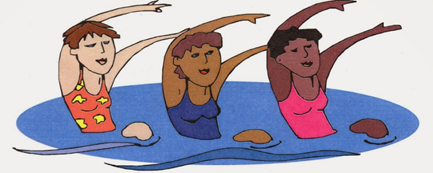
Ai Chi for Deep Water

Ai Chi (“energy of love”) is a water exercise and relaxation program that combines deep breathing and slow, large movements, performed in continuous, flowing patterns. It was created by Mr. Jun Konno of Japan and further developed my Ms. Ruth Sova in the United States. The YouTube video above shows Mr. Konno demonstrating Ai Chi.

Ai Chi, performed in shallow water, is so wonderfully relaxing that I wanted to try it with my deep water classes. This required modification, since weight shifting is not possible while suspended in deep water. I will present my modifications on Ai Chi Day, on Sunday July 25, 2021. The Zoom conference lasts from 8:00 AM – 12:00 noon EDT (7:00 AM – 11:00 AM CDT). There will be 18 presenters, including Jun Konno and Ruth Sova; my presentation is 10:10 – 10:19 AM EDT (9:10 – 9:19 AM CDT). If you are interested in attending, you can contact Ruth Sova at ruthsova@ruthsova.com for more information.

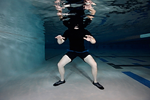
I am excited about presenting. Here is a preview of Ai Chi in deep water:

Contemplating
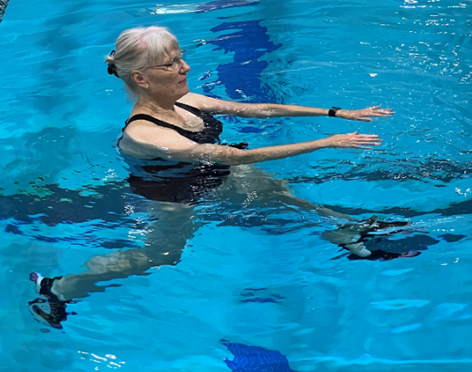
Floating
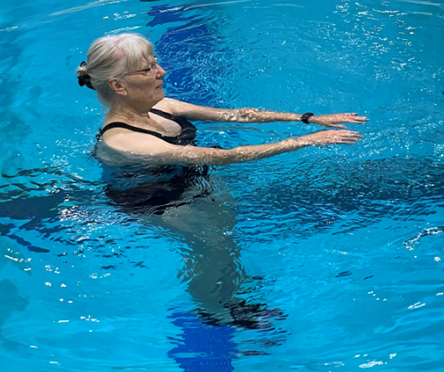
Enclosing

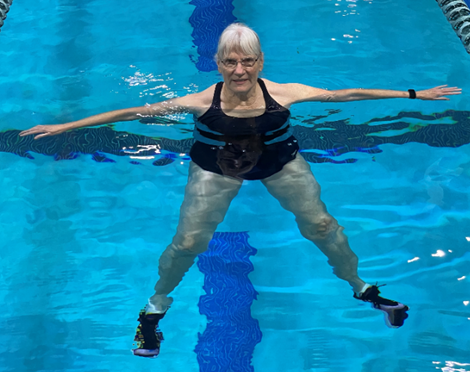
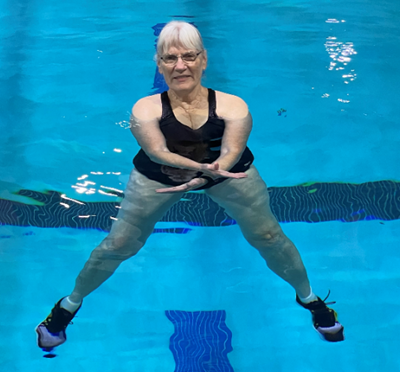
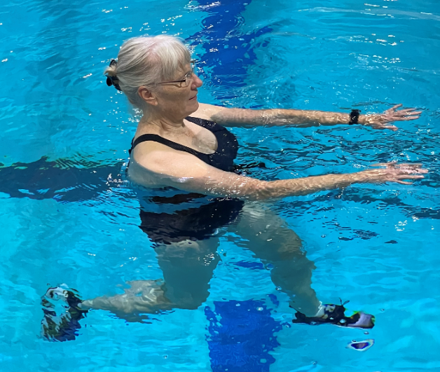
The first stage of Ai Chi is called Contemplating and it is a preparation for the moves to come. your body is in an upright posture with the spine in neutral and the legs apart. The arms are out to the sides near the surface of the water. Focus on your breathing. Inhale through the nose and exhale through the nose and mouth. Become aware of how your body rises and falls in the water. Then begin the first sequence, a series of four moves called Floating, Uplifting, Enclosing and Folding, which focus on breathing. They feature a series of arm moves. Most of the upper body moves work well in deep water, but upward movement, such as the front shoulder raise in Floating, tends to make the body sink. You can avoid sinking by turning the thumbs up and slicing through the water.

Gathering
Accepting

The second Ai Chi sequence focuses on healing, and includes exercises for the upper body and trunk stability. You will need to brace your core to stabilize in deep water. Webbed gloves can also help with stability if necessary. The movements in this sequence are called Soothing, Gathering and Accepting. The moves begin with a turn to the side. In deep water you will use a scull to assist in turning. The legs stay apart in a suspended lunge position while the arms sweep and flow. After you perform several repetitions of a move on one side, you turn to the other side and repeat the repetitions.

Balancing Begin
Balancing
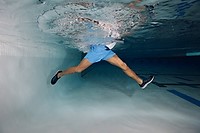
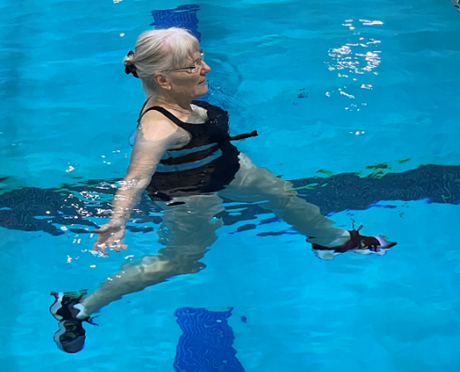
Balancing

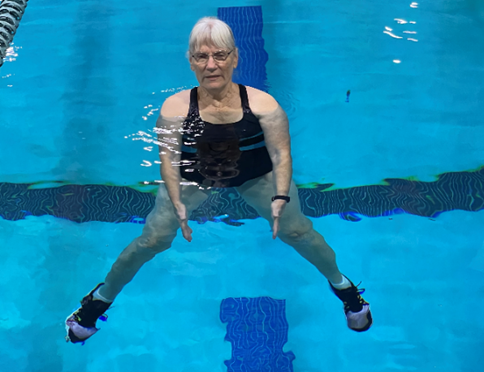
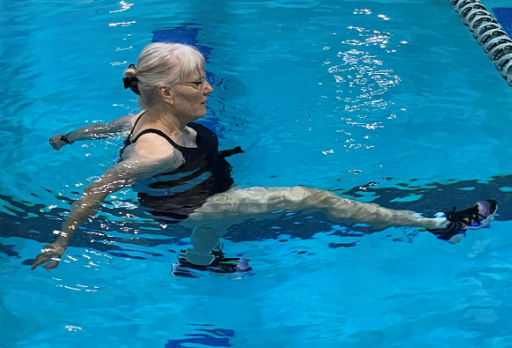
The third Ai Chi sequence is called healing and it focuses on the lower body. The moves are called Accepting with Grace, Rounding and Balancing. To get into position you turn to the side using a scull which puts the legs in a suspended lunge position. From there you need to drop the legs into neutral or the lower body movement tends to become a slow cross-country ski. Instead, brace the core and move one leg to the back, or to the front, or swing it front to back as in Balancing (in the photos above) while the arms sweep and flow. After performing several repetitions of each move on one side, turn to the other side and repeat the repetitions.

There is no right or wrong way to perform Ai Chi. Whatever adaptions you make, including deep water adaptations, will make it right for you. See you in the pool!

Author/Instructor Photo
Chris Alexander

Indoor Pools and Lightning

Florida Couple's Toilet Explodes As Lightning Strikes Near Septic Tank:  'Proof Why You Shouldn't Go Near the Bathroom in a Thunderstorm'

It is spring in Texas and that means thunderstorms. It may appear logical that pools and lightning don’t mix, and that is certainly true for outdoor pools. But what about indoor pools? The magazine Aquatics International ran an article in their January 2008 issue entitled “When Lightning Strikes” written by Tom Griffiths and Matthew Griffith. They argued that the practice of clearing indoor pools during outside thunderstorms does not keep people safe and in many cases, may put them in higher-risk situations.

First they looked at statistics from 1990-2003. During that time no deaths were recorded from lightning during indoor swimming activities. There had been 60 swimming pool electrocutions during that time but none of them were from lightning. The reason for that is that the National Electric Code, which has been adopted by every governmental body in the United States, requires all buildings to have the ability to shunt the voltage generated by a lightning strike. What that means is that a building must have a complete lightning protection system, and be properly grounded and bonded. Any indoor pool that is up to the required code is in violation of the National Electric Code section 250.4(A)(1) if they close during a thunderstorm.

The problem is that when the pool closes it puts swimmers and water fitness class participants at greater risk than if they had continued their pool activities. Typically they go to the locker rooms where they shower before changing. There have been numerous cases of shocks and electrocutions of people in showers, or at sinks washing their hands. Some swimmers will be children who have to call for a ride home. There are reports every year of people injured from being shocked while using a landline phone. People who leave the facility have to walk through the parking lot to get to their cars, exposing themselves to a direct lightning strike. In 2006, 99.5% of lightning-related fatalities occurred outdoors. Two occurred indoors, one to a teenager near a window and one to a person using a landline phone. Griffiths and Griffith refer to the idea that indoor pools should close during a thunderstorm as an “urban myth.”

In the June 2019 issue of Aquatics International, Shawn DeRosa followed up on the topic of lightning and indoor pools. He reported that researchers found that there continues to be no unanimity about whether to close an indoor pool during a thunderstorm. 62% of pools stay open. Of the facilities that required patrons to exit the pool, 43% allow patrons to use showers and sinks, and only 13% advised patrons to stay indoors.

Hopefully, your pool allows you to continue your water fitness class or your lap swimming or your swim lessons during a thunderstorm. It is the safest place for you to be. If your class ends or you finish your last lap, then exit the pool and dry off, but stay out of the showers and don’t wash your hands. Give your child a cell phone if he needs to call for a ride home. Then stay indoors, away from large windows or open doors until the storm passes. Stay safe!

See you in the pool!

Author/Instructor Photo

Chris Alexander

.

How to Adjust Your Fitness Routine When You-re Stuck at Home

Stuck at home? Dreaming of the days early last year when you were killing it at your local aquatic center? Well, you’ve come to the right place. With a little tweaking of your routine, a willingness to try new things, and the determination to see it through, you can stay in shape until you feel safe enough to return to the pool.

Water Fitness Lessons is dedicated to aquatic fitness. For guidelines on how to safely swim during the pandemic as well as other helpful insight, be sure to bookmark my blog!

Exercising When You Can’t take an Aquatic Fitness Class. If your favorite physical activity is water exercise or swimming, and you’re still not ready to get into the water, there are other ways to stay active until it’s time to jump back in the pool:

Finding Effective Home Workouts. In addition to biking or running, look to at-home workouts to switch up your routine and keep your muscles guessing:

Staying Motivated. It’s important to find ways to stay motivated, so find some tried and true ways to make these new routines stick:

Yes, sticking with your aquatic fitness routine is great, but until you can get back there, find other ways to take care of yourself. Exercise, eat right and stay well.

This guest Blog post was written by Anya Willis. Check out her website at FitKids

We hope to see you back in the pool soon!

Author/Instructor Photo

Chris Alexander

CDC Guidelines for Pools

senior women led by female instructor at water aerobics A group of senior ladies take part in a water aerobics session. They are using pool noodles and are being led by a young female instructor. They are all laughing and smiling water aerobics stock pictures, royalty-free photos & images

The CDC is not aware of any scientific reports of the virus that causes COVID-19 spreading to people through the water in pools, water playgrounds, or other treated aquatic venues. The virus most commonly spreads from person-to-person by respiratory droplets during close physical contact. Droplets are released when an infected person coughs, sneezes or talks. They can then land in the mouths or noses of people who are nearby or possibly be inhaled into the lungs. The virus might also spread to hands from a contaminated surface and then to the nose, mouth, or possibly eyes. Infected people can spread the virus whether or not they have symptoms.

It has not been easy for many people to maintain their level of fitness while sheltering in place, and we are eager to get back to our regular exercise routines. If that means taking a water fitness class, the CDC has recommendations for you to be able to do that safely.

  • Correctly and consistently wear a mask that completely covers your nose and mouth. See my previous post “More about Masks” for more information https://waterfitnesslessonsblog.com/2021/01/30/more-about-masks/ Wear the mask until just before you get into the pool. You should not wear the mask in the water because a wet mask it is hard to breathe through. After class dry your hands and face and put the mask back on.
  • Arrive at the pool with your swim suit on, ready to get in the water. This eliminates or at least minimizes the amount of time you spend in the locker room.
  • Stay at least six feet away from others who do not live with you. Six feet is a few inches longer than a typical pool noodle which is a good image to help you visualize the proper distance. Six feet is a good separation if your class is low intensity, for example aqua yoga or light aerobics. However, if your class involves sweating and heavy breathing, such as high intensity interval training, then air is coming out of your mouth with more force and traveling farther. For that reason, you should spread farther apart. In my classes we use periodization, beginning with low intensity in the pre-season and working up to high intensity during peak fitness. If you want to go all out during peak fitness then you will want to be 12-15 feet away from other participants.
  • Avoid crowds. Do not congregate on the pool deck with other participants unless you have your mask on and are standing 6 feet apart.
  • Do not share equipment. Since there is a chance that you could pick up the virus from a contaminated surface, deep-water belts and pool equipment should be sanitized before using them again.
  • Stay home when you are sick.
  • Wash your hands frequently with soap and water for at least 20 seconds or use hand sanitizer with at least 60% alcohol.
  • Get vaccinated when the vaccine is available to you. Getting vaccinated does not mean that you can dispense with the previous recommendations. The vaccines are not 100% effective, so you might still get infected. New variants of the disease are circulating that are more contagious. It is expected that if you did get infected after you were vaccinated, you would have a mild case or perhaps no symptoms at all. Little is known about whether vaccinated people can spread the virus to others.
  • Get tested if you have signs or symptoms of COVID-19, or if you think you may have been exposed to someone with COVID-19.

For more information on CDC Guidelines, see https://www.cdc.gov/coronavirus/2019-ncov/daily-life-coping/beaches-pools.html Additional information for this article comes from NPR November 20, 2020, NY Times 4/15/2020, The Dallas Morning News 2/8/2020 and 2/9/2020.

The last thing any of us want is a new surge of infections before enough people have been vaccinated that we achieve herd immunity. It is not known exactly what proportion of the population that would be, as the rate varies by disease. For now, continue to wear a mask, maintain social distancing, wash your hands, and sign up to get the vaccine when you can.

See you in the pool!

Author/Instructor Photo

Chris Alexander

More about Masks

The Coronavirus is mutating and newer variants have emerged in the United Kingdom, South Africa and Brazil. These variants are more contagious than the version that is currently causing most of the cases of COVID-19 in the United States. The new variants have already been detected in the United States and may become more dominant here in the coming weeks. It is therefore important to continue wearing masks, stay 6 feet apart and avoid crowds. COVID-19 spreads mainly from person to person through respiratory droplets. Respiratory droplets travel into the air when you cough, sneeze, talk, shout, or sing. These droplets can then land in the mouths or noses of people who are near you or they may breathe these droplets in. Masks are a barrier that prevents your respiratory droplets from reaching others. Masks also offer some protection to you as well. To increase the protection when you are going to be in an area with a lot of other people, you might even consider wearing two masks. Medical masks and N-95 respirators should not be used because they should be conserved for healthcare personnel. Aside from those, there are several varieties of masks available, and some of them are more effective than others.

Coronavirus Masks: Types, Protection, How & When to Use

Non-medical disposable masks are made of fluid resistant paper and are recommended by the CDC. They are not the same as surgical or other medical masks. They are good in situations where your mask is likely to get wet or dirty. Bring extra disposable masks with you in case you need to change out a wet or dirty mask. Discard them after a single use.

Five Tips for Wearing a Face Mask

Cloth face masks made with breathable fabric, such as cotton and cotton blends are also recommended by the CDC. The fabric should be tightly woven. Hold the fabric up to a light source and if you can see light through the fabric, then it is a loosely woven or knit fabric, which is not recommended. If you don’t see light through the fabric, then the material is tightly woven. There should be 2 or 3 layers of fabric. Single layers work less well because there is not as much material between you and the microbe.

How to make a Face Mask Filter with HEPA Fabric - video tutorial —  SewCanShe | Free Sewing Patterns and Tutorials

Masks with an inner filter pocket are also recommended by the CDC. Use a PM2.5 filter or a HEPA filter, which can be purchased online. You can also use a coffee filter cut to fit. The filter can be reused, but discard it after a week, or sooner if it is used every day.

Gaiter Mask Face Covers | Ohio Is Home

Gaiters are not recommended because they tend to be single-layer cloth, and they do not usually offer a snug fit.

How to Turn a Bandana into a Stylish Face Mask – Spirit Halloween Blog

Scarf and bandana face masks are also not recommended. Not only is the fabric single layer, it most likely will not be tight around the mouth and nose. Good fit matters.

Why masks with breathing valves don't stop COVID-19 spread

The CDC does not recommend using masks with exhalation valves or vents because this type of mask may not prevent you from spreading COVID-19 to others. The hole in the material may allow your respiratory droplets to escape and reach others.

Make sure your mask fits properly. The more snug the fit, the better. Avoid masks with gaps that allow droplets to escape. Do not wear a mask with your nose or mouth uncovered.

How to Wash a Cloth Face Covering | CDC

If you have a disposable mask, throw it away after wearing it once. Wash a cloth mask whenever it gets dirty or at least daily. It was previously recommended that you wash your mask in a bleach solution, but that is no longer recommended because toxic bleach fumes can remain in the fabric. The CDC now recommends that you wash masks in the washing machine with your regular laundry, using laundry detergent and the appropriate settings according to the fabric label. You can also wash by hand with detergent or soap, being sure to rinse thoroughly. Dry your mask completely in the dryer. You can also hang it in direct sunlight. If that is not possible, hang or lay it flat and let dry completely.

If you are taking your mask off temporarily, for example to eat or drink outside of your home, you can place it somewhere safe to keep it clean, such as your pocket, purse or a paper bag. Make sure to wash or sanitize your hands after removing your mask. Put your mask back on with the same side facing out, and wash or sanitize your hands again afterwards.

For more information on masks see the January/February AARP Bulletin “How to Beat COVID This Year.” Also see the CDC Guidelines for Wearing Masks and the CDC Guidelines on How to Store and Wash Masks.

Stay safe!

Author/Instructor Photo

Chris Alexander