Anxiety is normal. As your body’s reaction to danger, anxiety can protect you in challenging, threatening, or heavy-pressure situations. However, when you deal with regular anxiety attacks, they can negatively impact your health and well-being.
Anxiety attacks, or panic attacks, refer to moments of extreme fear or panic. These episodes typically come out of nowhere and can be difficult to control once they start. Most anxiety attacks cease within 10 to 30 minutes.
If you suffer anxiety attacks on a regular basis, now is the time to take action. Consider these practical methods for preventing them in the future:
Leave Your Job
One of the most common sources of frequent anxiety and anxiety attacks is work. If you are getting anxious at your job, think about shifting your career. These days, there are accredited online universities that allow you to earn a degree without ever going to a campus. If you need to further your education and training so that you can succeed in a new line of work, this might be the way to go. You can pursue an online bachelor’s degree in IT, business management, healthcare management, or any number of other fields.
Breathe In, Breathe Out
One effective way to prevent panic attacks, or stop a current attack, is to relax your body and focus on your breath. The next time you feel anxiety crouching at your door, try this simple exercise:
Close your eyes.
Slowly breathe in through your nostrils for five seconds.
Hold your breath for five seconds.
Release your breath through your mouth for five seconds.
Repeat these steps for one minute.
You could also sign up for a class or find an online tutorial that covers breathing techniques, meditation, and other relaxation activities.
Avoid Harmful Substances
Sometimes, the culprit of an anxiety attack is simply the substances we consume. If you naturally deal with anxiety and you drink a lot of caffeine or alcohol, you are likely not doing yourself any favors. The same goes for nicotine; while many people smoke cigarettes to calm their nerves, nicotine tends to increase anxiety rather than decrease it.
Eat Well and Exercise
It’s also important to take care of your physical health because it is closely related to your mental and emotional health. Make sure you’re abiding by a nutritious, balanced diet each day. While you may not need to adopt the strictest diet out there, you do want to be mindful of limiting the processed foods, salt, fat, and sugar you consume.
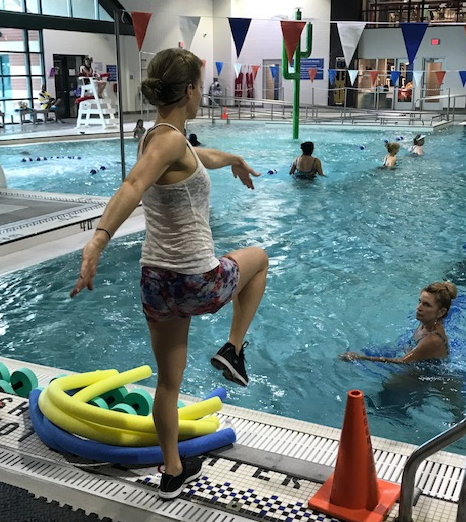
Also, find a physical activity you enjoy, and get into a consistent fitness routine. Whether it is playing a recreational sport, running, walking, swimming, or doing any other activity, you might be surprised by how much better you feel when you get into a rhythm. Turn to online sources like Water Fitness Lessons if you need ideas for getting started!
Prioritize Quality Sleep
Sleep deprivation can make your anxiety worse, and adults need at least seven hours of restful sleep each night to promote health and productivity. The problem is that anxiety is a common culprit when it comes to sleep problems. Try to develop a bedtime routine that relaxes your mind and body; meditating, listening to soft music, and avoiding electronic screens have been known to help people fall asleep and stay asleep.
Maintain Your Close Relationships
Lastly, don’t allow isolation and loneliness to trigger or exacerbate your anxiety. Stay connected to close relatives and friends with whom you can share your worries and enjoy your time. Meet people in person when possible, but at the very least, keep up through video chat and other online channels. The point is that you don’t become an island of one, which can keep you in a harmful cycle of anxiety.
While not all anxiety is bad, you need to address your anxiety if it is controlling your life. Consider the tips above as you look to make meaningful changes to your routine, and keep researching other ways that you can keep your anxiety at bay. Before long, you will be calmer and more able to navigate the challenges that life brings.
As the holiday season approaches, it is time to plan for a little holiday fun with your water fitness class. Start by breaking out the holiday music. If you don’t have a holiday playlist, you can download one from any of the fitness music companies. Yes Fitness Music has: Xmas Buzz, SS Classic Christmas, FREE Holiday Medley, and Super Happy Xmas. Dynamix has Christmas Pop Hits 2, Winter Wonderland 1, and Winter Wonderland 2. Fit Mix Pro has Christmas Party, Christmas Party 1, Aqua Freedom Christmas, Cardio Christmas and many more. Muscle Mixes Music has Core Christmas and Core Christmas Vol. 2, Christmas in Motion, and Christmas Jingles. Power Music has Tabata Power Mix (Holiday Edition), Tis the Season (Best of Christmas Hits Remixed), Tis the Season 2 (Christmas Power Mix Step), Tis the Season (Christmas Power Mix Aerobics), Christmas Hits Remixed, and Christmas Hits Remixed Vol. 2. If the playlist you like is not the right beats per minute for your class, then download Tempo Magic from the app store. It adjusts the tempo of your playlist without making it sound like you are playing the music in slow motion when you lower the beats per minute, or making it sound like Alvin and the Chipmonks when you increase the beats per minute.
Now for the fun. Here are two ideas to add some holiday sparkle to your water fitness class:
The Twelve Days of Christmas
Select an exercise to go with each of the twelve days of Christmas, and teach the class as add-on choreography. You can pick any exercise you like, but here are some ideas to get you started.
Partridge in a pear tree – Jumping jacks
Turtle doves – Inner thigh lift doubles
French hens – Jog 3X and hold
Calling birds – Kick forward 4X, kick backward 4X
Golden rings – Jog in a circle
Geese a-laying – Pelvic floor exercise
Swans a-swimming – Jog with crawl stroke
Maids a-milking – Steep climb with milking arm motions
Ladies dancing – Swing a partner
Lords a-leaping – Leap
Pipers piping – Wide jog with side stroke
Drummers drumming – Wide jog, hands press down in front as if drumming
Holiday Obstacle Course
Set up stations like a circuit class around the pool in advance. Then divide your class into two groups. Group one will be helpers while the second group runs through the obstacle course. After the second group completes the course, they become the helpers while the first group runs through.
Starting Gate
Station One
Station Two
Station Three
Station Four
Station Five
Station Six
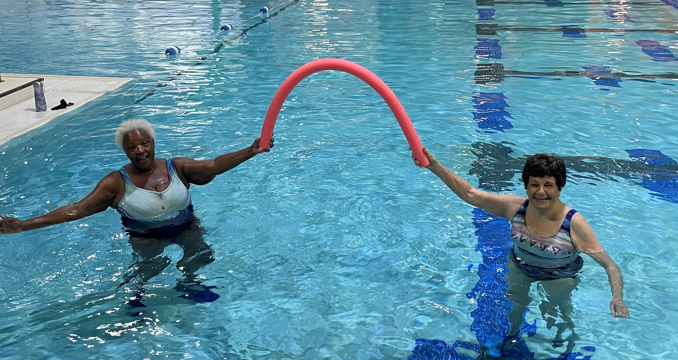
Starting Gate. Two helpers hold the ends of a noodle up to form an arch that the participants run through to begin the obstacle course.
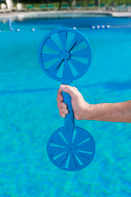
Station One. Cross-country ski to the North Pole using Aqualogix Bells. If you do not have bells, you can use foam dumbbells or paddles.
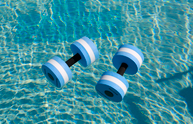
Station Two. Make snow angles by performing jumping jacks with foam dumbbells.
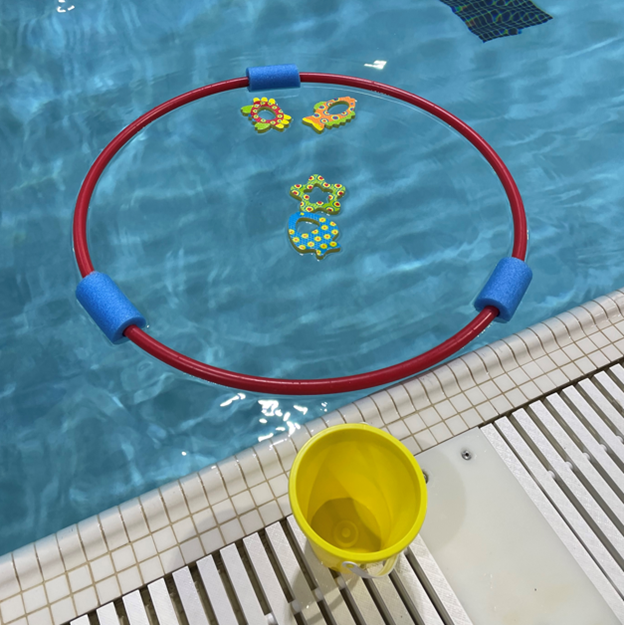
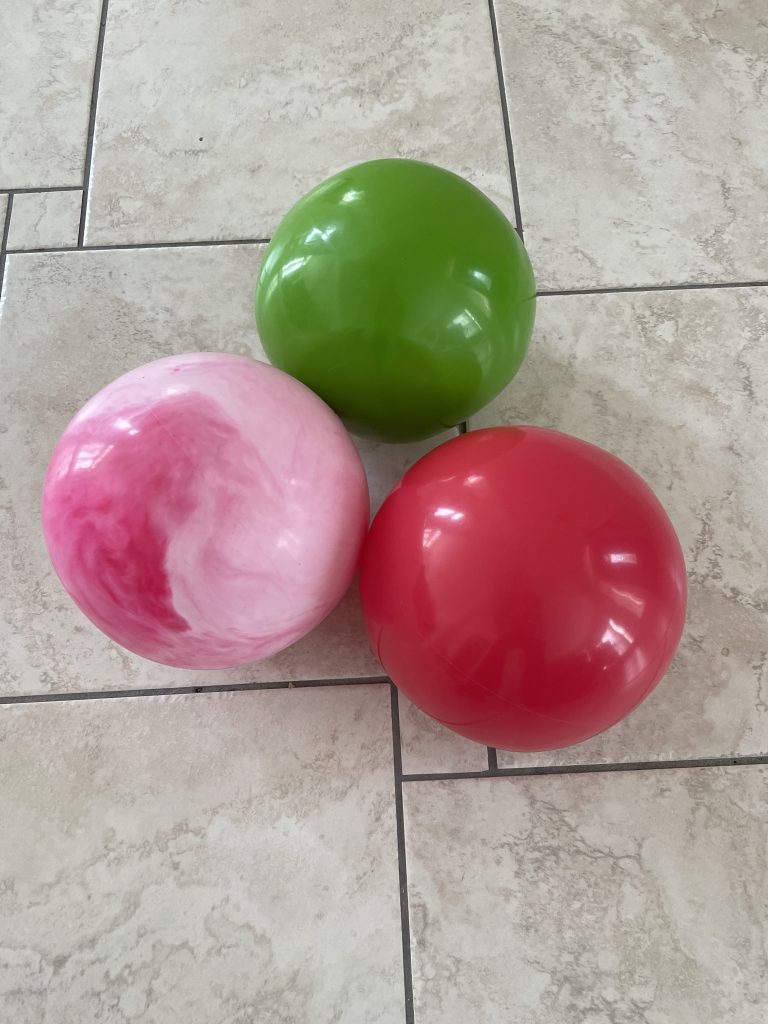
Station Three. Decorate the tree. Cut some pieces off a noodle that has a hole in the middle. Slice the pieces just to the hole. Attach the pieces to a hula hoop so that it will float, as in the photo. If you don’t have a hula hoop, you can rubber band the ends of two noodles together to form a circle. A helper has pool toys or balls in a bucket, and the participant stands some distance away and tries to toss the toys into the hoop.
Station Four. Stir the cookie dough. Hold a paddle in the freehold position and perform a stirring motion. If you do not have paddles, then you can paddlewheel like an electric mixer with foam dumbbells instead.
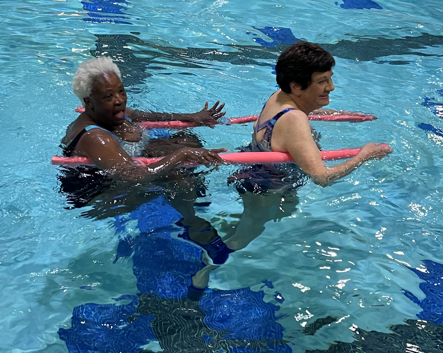
Station Five. Test the bicycles in the toy shop. Straddle a noodle and bicycle some distance away and back.
Station Six. Load Santa’s sleigh. Have two or three helpers stand in a line each holding a ball. The participant tosses a ball back and forth a few times with each helper.
Station Seven. Pull Santa’s sleigh. A helper plays Santa by holding the ends of two noodles under his/her arms. The participant stands with his/her back to Santa and pulls the sleigh to deliver the toys to the finish line.
Station Seven
The finish line. The same two helpers who held a noodle up to form an arch at the beginning of the obstacle course, now serve as the finish line. This activity is sure to bring your participants lots of giggles and leave everyone in the holiday spirit.
Here’s wishing everyone a happy holiday season! See you in the pool!
Whether you teach water fitness classes, work as an aquatic therapist, or attend a class or session as a participant, there are certain things that you need to have. Instructors need certifications, continuing education, and sometimes help with lesson planning. Everyone needs swimwear and shoes they can wear in the pool. Fitness equipment designed for the aquatic environment is a must. Music is a great motivator used in many classes. The purpose of this article is to provide you with information and reviews for a variety of these resources as well as links to websites where you can purchase them.
Certifications
Ruth Sova
The Aquatic Exercise Association (AEA) was founded by Ruth Sova who then went on to found the Aquatic Therapy and Rehab Institute (ATRI). The two organizations recently merged. AEA’s certification is accepted in many countries around the world. AEA recommends that you get at least 6 months experience before applying for the certification. Their Aquatic Fitness Professional Manual costs $68. Their online exam is $165. The optional (but highly recommended) online prep course is $209. The certification is good for 2 years. A minimum of 15 continuing education credits (CECs) is required to renew. ATRI offers a certification for people interested in aquatic therapy, rehab and therapeutic exercise. AEA members get Akwa magazine, with excellent articles on aquatic fitness. You don’t need an AEA certification to become a member.
John Spannuth
The United States Water Fitness Association (USWFA) was founded by John Spannuth. It was the first organization to offer a certification for water fitness instructors. The certification is a home study course, costing $277. When you sign up, they send you the National Water Fitness Instructors Manual, an open book test and some forms to fill out. You have to teach a section of an experienced instructor’s class and then both of you fill out an evaluation. The certification is good for 3 years. You take another open book test to renew. The USWFA offers additional certifications: the Aquatic Directors certification, the Deep Water certification, the Aquatic Fitness Personal Trainers certification, the Aquatic Wellness Coach certification, and the Water Walking Instructors certification. The Aquatic Directors manual addresses the issues facing aquatic facilities in the post-pandemic period.
Sara Kooperman
SCW was founded by Sara Kooperman as a series of Mania fitness pro conventions in the Midwest, Dallas, Boston, D.C., California, Florida and Atlanta. The conventions offer continuing education training for land fitness instructors and personal trainers as well as aquatic fitness instructors. SCW expanded to offer certifications in Aquatic Exercise, Group Exercise, Personal Training, Active Aging and many more. The Aquatic Exercise certification is an online course costing $199. It is good for 2 years and requires 20 CECs to renew. SCW created WaterinMotion, a pre-choreographed, quarterly-released group exercise program that refreshes the moves and music every 3 months. You can also sign up on the SCW website for free webinars, Spotlite e-news, and Tidal Waves e-news.
AEA offers both in person and online continuing education. The International Aquatic Fitness Conference (IAFC) is held in May and they offer CEC trainings in locations around the country. Check their website for a calendar of events. In addition to their Mania fitness pro conventions, SCW offers CEC video courses in the SCW Store on their website. Laurie Denomme has created a Water Exercise Coach program that teaches you how to lead workouts to get your students results. Exercise Etc. Inc. offers online education on a variety of fitness topics. It’s an easy way to collect the last few CECs needed to renew a certification. Mark Grevelding founded Fitmotivation, an aquatic video streaming service. The basic plan costs $14.95 a month, and the premium plan costs $24.95 a month. Two or three new videos are added every month. Some of the videos include AEA online quizzes worth continuing education credits that you can take for $20 with the basic plan or $10 with the premium plan. If you just want to stream videos to work out in your backyard pool, Mark offers a program for that too, Pool Fit.
Books
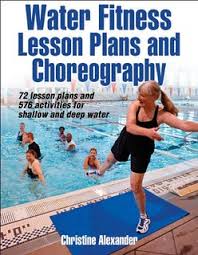
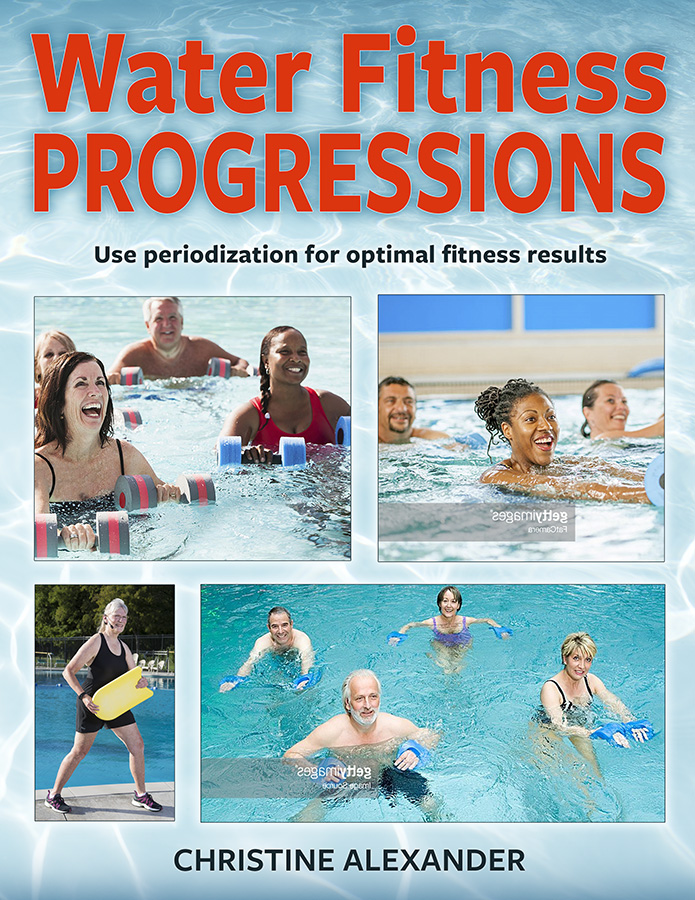
Some people like having a book to refer to when they need ideas. I wrote 2 books on water exercise each published by Human Kinetics. Water Fitness Lesson Plans and Choreography (2011) was written for water fitness instructors. It has 36 class ideas for shallow water exercise and 36 ideas for deep water exercise. Individuals may find the exercise descriptions and photos in Chapter 2 and Chapter 5 useful for building a personal exercise routine. Water Fitness Progressions (2019) was written for water fitness instructors and aquatic personal trainers. It describes how to use periodization to help class participants and clients progress in their level of fitness. It contains lesson plans that illustrate how to progressively increase intensity for both cardiorespiratory endurance and strength training. Gregory James Keyes has written Aqua-I-Cue: The Quintessential Aquatic Exercise Sports Science Reference Manual, which offers a wealth of information covering topics found in certification manuals and much more. It is available as a download on Amazon.
Swimwear
Your swimsuit is your most basic piece of aquatic fitness equipment, and there are many websites where you can order them. These include, in alphabetical order: D&J Sports, Dolfin, H20 Wear, Kiefer, Lands End, Speedo, Splash International, Swim and Sweat,Swim Outlet, SwimSuits for All, TYR, and Xtreme Swim. H20 Wear has been making the longest-lasting, chlorine-resistant swimwear available for 33 years, and they also sell apparel and water shoes. SwimSuits for All sells swimsuits for a variety of body types. TYR makes swim jammers for men. For a review of the 20 best athletic and sporty swimsuits that are flattering and functional for women, published in May 2021, check out Prevention.com. And for men, Sports Fitness Advisor wrote a review of swim jammers in August 2021.
Water Fitness Shoes
One of the best known women’s shoe for water fitness is made by Ryka. They are designed specifically for a woman’s foot. But men are taking water fitness classes too, and there are many companies that make water fitness shoes. Shoes Grow – Step Up in Life posted an article called The Best Shoes for Water Aerobics. Another review of water shoes was posted by Surfango.
Aquatic Fitness Equipment
Foam dumbbells, pool noodles, drag equipment, and deep-water belts are some of the types of equipment made for aquatic exercise and aquatic therapy. Craig Stuart was the first to make foam dumbbells, starting Hydro-Fit to sell them. Hydro-Fit also makes webbed gloves, pool noodles, deep-water belts, cuffs, apparel, and equipment for aquatic therapy. I have to admit that I am a big fan of Hydro-Fit. I am especially fond of the webbed gloves. Everything I have purchased from them is of good quality, and lasts a long time. The only place to buy Hydro-Fit products is from their website. Drag equipment is a good training choice, and the drag equipment I like best, other than webbed gloves, are Aqualogix bells. Aqualogix also makes fins to increase drag resistance on the legs. Another interesting type of drag equipment is the Aqua-Ohm, created by Irene and Marco, a couple of aquatic physical therapists. Other sellers of aquatic fitness equipment are, in alphabetical order: Aquajogger, Hydro-Tone, Sprint Aquatics, Water Fit, Theraquatics, and Water Gear. Some of the websites that sell swimsuits also sell equipment, including D&J Sports, Kiefer, Splash International, Swim Outlet, and Xtreme Swim. Best Reviews posted an article in September 2021 on their picks for the 5 Best Aquatic Dumbbells. You might also want to check out the post in Your Swim Book on the Five Best Pieces of Water Exercise Equipment for Crushing Your Pool Workouts.
Music
Many people wouldn’t think of exercising without music! If you are teaching a class, you want to use music created especially for fitness classes, using the appropriate beats per minute. Yes Fitness Music lets you purchase individual playlists, or you can have unlimited access to their entire fitness music library with a Yes!Go Subscription plan, costing $149.95 for a year or $14.95 a month. Dynamix offers pre-mixed albums or you can create your own custom downloads. Fit Mix Pro offers custom mixes only. Muscle Mixes Music and Power Music offer pre-mixed playlists. If you are interested in a microphone, the only waterproof mic on the market is the Evo sound system available at Special Projects Audio by Galaxy.
If I missed one of your favorite vendors, put a comment at the bottom of this article. See you in the pool!
There are those who are passionate about deep-water exercise (and I am one of them). But for those who have never tried it, there is a degree of mystery about it. One of the concerns I hear most often is: “I don’t think I could tread water for an entire one-hour class.” You don’t have to! Everyone should wear a flotation belt in deep water. The second concern I hear is: “Can you get a workout in deep water as intense as the workout in shallow water? And the answer is definitely, yes!
Let’s back up to that flotation belt. It needs to be attached tightly around your waist so that it doesn’t slide up under your arm pits. And then you need some practice stabilizing, since your feet don’t touch the pool floor and there may be a tendency to tip forward or backward. The core muscles have to learn to contract to keep you upright, which is why most people see improvements in their core strength after taking a deep-water class for awhile. The second thing you need to learn is to continue to maintain that upright position in which you work against the water’s resistance with your entire body from the neck down, instead of trying to streamline by rounding forward, as in the drawing with the big X through it. In this position the bones of your spine are compressed on the front side, which is not good for the back.
Now, let’s talk about getting an intense workout in deep water. This means high intensity interval training (HIIT) where you work at 80-90% of your maximum effort for short periods followed by periods of active recovery. Achieving maximum effort requires focus. Your focus determines the number of muscle fibers that need to contract and the speed of those contractions. It’s important, then, that you are actively engaged, not reminiscing about vacation or chatting with another participant, when you are performing HIIT. The strategies for achieving high intensity in deep water are similar to the strategies in shallow water, but with some differences.
Step One: Start with the Base Moves. In deep water the base moves are jog, bicycle, kick, cross-country ski, and jumping jacks. These moves all have multiple variations. (1) Jog. You can jog with the feet hip distance apart or wide. You can cross the midline in front with an inner thigh lift or cross the midline in back with hopscotch. You can lift the knees in front or the heels in back. You can lean diagonally to the side or go all the way to side-lying. (2) Bicycle. Bicycle with the feet under you as if you are on a unicycle. You can bicycle tandem, with the feet pedaling in unison. You can lean diagonally to the side or go all the way to side-lying. (3) Kick. You can flutter kick, kick forward, kick across the midline, Cossack kick like a Russian dancer, or kick backward. (4) Cross-country ski. You can ski upright, add a tuck, lean diagonally to the side or go all the way to side-lying. (5) Jumping jacks. You can add a tuck or perform the jacks seated, with knees bent or in an “L” position. All the base moves can be varied by using different arm movements or different foot positions.
Step Two: Increase the Range of Motion. Large moves take more effort than smaller moves. Increasing the range of motion is one intensity variable. Get the knees high in your jog and pump the arms in big movements. Start your inner thigh lift with the feet wide apart and lift the inner thigh high. Start your hopscotch with the feet wide too. Bicycle in large round circles. Kick higher – front or back. Perform cross-country ski with your full range of motion, or do a helicopter ski, moving the legs in semi-circles around the body instead of in straight lines. Take your feet as wide as comfortably possible in your jumping jacks and cross the legs in the center. Focus on achieving your full range of motion. Depending your level of fitness, you may find large moves to be really intense. Alternate base moves with exercises using full range of motion for your intervals until that becomes easier.
Step Three: Add Speed. Faster moves increase intensity. The tendency, however, is to decrease the range of motion as speed is increased. You work much harder if you maintain the same full range of motion while speeding up. Pay attention to your exercises to avoid slowing down. Speed is a second intensity variable. Alternate base moves with faster exercises for your intervals until that becomes easier.
Step Four: Add Acceleration. There are two ways to do this. (1) Accelerate your leg movements toward center to lift your shoulders out of the water. This is called adding elevation. Examples are frog kick, breaststroke kick, cross-country ski, and tuck ski together (scissors kick). The body will rise and sink rhythmically. You can also use a scull to lift your shoulders out of the water with a jog, bicycle or flutter kick. Aim to stay elevated with your scull. (2) Accelerate against the water’s resistance, or add more force to the move. Take your jog to a steep climb by stretching out your arms and pressing alternating hands down while at the same time lifting the knees high and then pressing the heels down toward the pool floor, as if climbing a steep mountain with trekking poles. Lift your inner thigh with power as your press the opposite hand down forcefully toward the thigh. Bicycle with power as if you are climbing a hill in first gear. Perform a high kick powering the leg on the downward phase, or power both upward and downward. Kicks backward, cross-country ski and jumping jacks can all be performed with power. Be mindful about what you are doing because the harder you push against the water, the harder the water pushes back. Acceleration is a third intensity variable. Alternate base moves with accelerated moves for your intervals until that becomes easier.
Step Five: Combine Intensity Variables or Work in More than One Plane. One strategy for continuing to perform HIIT once you have achieved your fitness goals is to combine intensity variables. Go for full range of motion with power, elevation with speed, or power with travel continuing to use force as you move across the pool. Another strategy is to work in two or three planes at once. You can do this by alternating one move in the frontal plane, such as a frog kick with another move in the sagittal plane, such as a tuck ski together. A second way to work in multiple planes is to combine arm moves in one plane with leg moves in another plane. Examples include jumping jacks (frontal plane) with clapping hands (transverse plane); cross-country ski (sagittal plane) with arms sweeping side to side (transverse plane); and high kick (sagittal plane) clapping over the kick (transverse plane) then under the kick (frontal plane). Continue to focus on what you are doing, and your periods of high intensity will leave you breathing hard. You will need those periods of active recovery to catch your breath. For more information on interval training in both deep water and shallow water, including lesson plans using these five steps, see my book Water Fitness Progressions.
High intensity interval training (HIIT) is working at 80-90% of your maximum effort for short periods followed by periods of active recovery in which you work at a lower intensity. Achieving maximum effort requires focus. Your focus determines the number of muscle fibers that need to contract and the speed of those contractions. It’s important, then, that you are actively engaged, not reminiscing about vacation or stressing about your workday, when you are performing HIIT. The American College of Sports Medicine recommends at least 30 minutes of moderate intensity exercise five days a week, or 20 minutes of high intensity exercise three days a week. That means that if you work at a high intensity, you meet your exercise goal in less time. For that reason, HIIT is popular in all types of exercise, both on land and in the water. Whether you are taking a water fitness class or working in your backyard pool, you may be wondering how to achieve high intensity in the water.
Step One: Start with the Base Moves. In shallow water the base moves are walk, jog, kick, rocking horse, cross-country ski, and jumping jacks. Walking is good for warming up and cooling down. Jog, kick, rocking horse, cross-country ski and jumping jacks all have multiple variations. (1) Jog. You can jog with the feet hip distance apart or wide. You can cross the midline in front with an inner thigh lift or cross the midline in back with hopscotch. You can lift the knees in front or the heels in back. (2) Kick. You can kick forward, kick across the midline, kick side to side, or kick backward. (3) Rocking horse. Rocking horse can be done front to back or side to side. (4) Cross-country ski, jumping jacks and all the base moves can be varied by using different arm movements or different foot positions.
Step Two: Increase the Range of Motion. Large moves take more effort than smaller moves. Increasing the range of motion is one intensity variable. Get the knees high in your jog and pump the arms in big movements. Start your inner thigh lift with the feet wide apart and lift the inner thigh high. Start your hopscotch with the feet wide too. Kick higher – front, side or back. Lift your knees high in front and your heels high in back with your rocking horse. Perform cross-country ski with your full range of motion. Take your feet as wide as possible in your jumping jacks and cross the legs in the center. Focus on achieving your full range of motion. Depending your level of fitness, you may find large moves to be really intense. Alternate base moves with exercises using full range of motion for your intervals until that becomes easier.
Step Three: Add Speed. Faster moves increase intensity. The tendency, however, is to decrease the range of motion as speed is increased. You work much harder if you maintain the same full range of motion while speeding up. Pay attention to your exercises to avoid slowing down. Speed is a second intensity variable. Alternate base moves with faster exercises for your intervals until that becomes easier.
Step Four: Add Acceleration. There are two ways to do this. (1) Accelerate off the pool floor, or jump. Take your jog to a leap and your wide jog to a frog jump. Perform your inner thigh lift and hopscotch with a rebound. Rebound with your kicks as well. Jump and tuck your feet under you with cross-country ski. With jumping jacks, jump and touch your heels together before landing with your feet wide. (2) Accelerate against the water’s resistance, or add more force to the move. Take your jog to a steep climb by stretching out your arms and pressing alternating hands down while at the same time lifting the knees high and then pressing the heels down toward the pool floor, as if climbing a steep mountain with trekking poles. Lift your inner thigh with power as your press the opposite hand down forcefully toward the thigh. Perform a high kick powering the leg on the downward phase, or power both upward and downward. Kick side to side with arms and legs opposite, adding power to the move. Instead of rebounding as you kick side to side, you can stay grounded, and you might be surprised at how hard it is. Karate front kicks and side kicks also involve using force against the water. Kicks backward, cross-country ski and jumping jacks can all be performed with power. Try the cross-country ski low in the water so that more of your body has to push against the water’s resistance. Be mindful about what you are doing because the harder you push against the water, the harder the water pushes back. Acceleration is a third intensity variable. Alternate base moves with accelerated moves for your intervals until that becomes easier.
Step Five: Combine Intensity Variables or Work in More than One Plane. One strategy for continuing to perform HIIT once you have achieved your fitness goals is to combine intensity variables. Go for full range of motion, speed and jumping, or full range of motion, speed and power all at the same time. You can also continue to accelerate while traveling, either by rebounding and jumping or by continuing to use force as you move across the pool. Another strategy is to work in two or three planes at once. You can do this by alternating one move in the frontal plane, such as a frog jump with another move in the sagittal plane, such as a tuck ski. A second way to work in two planes is to combine arm moves in one plane with leg moves in another plane. Examples include kick side to side (frontal plane) with arms sweeping side to side (transverse plane); cross-country ski (sagittal plane) with palms together sweeping side to side (transverse plane); and high kick (sagittal plane) clapping over the kick (transverse plane) then under the kick (frontal plane). Continue to focus on what you are doing, and your periods of high intensity will leave you breathing hard. You will need those periods of active recovery to catch your breath. For more information on interval training in the pool, see my book Water Fitness Progressions.
High intensity interval training is also done on land, and it’s always a good idea to cross train if possible, doing some of your workouts in the pool and some on land. For those who are not comfortable training in a gym, you can still do HIIT at home. If you enjoy walking in your neighborhood, try picking up the pace to a fast walk for short periods, again being mindful of what you are doing, followed by periods of walking at your normal speed for active recovery. As you continue to practice, you will find that the pace of your fast walking increases. If you prefer to run, try HIIT running. There is some great information on HIIT running at home on Garage Gym Reviews at https://www.garagegymreviews.com/hiit-running-workouts